


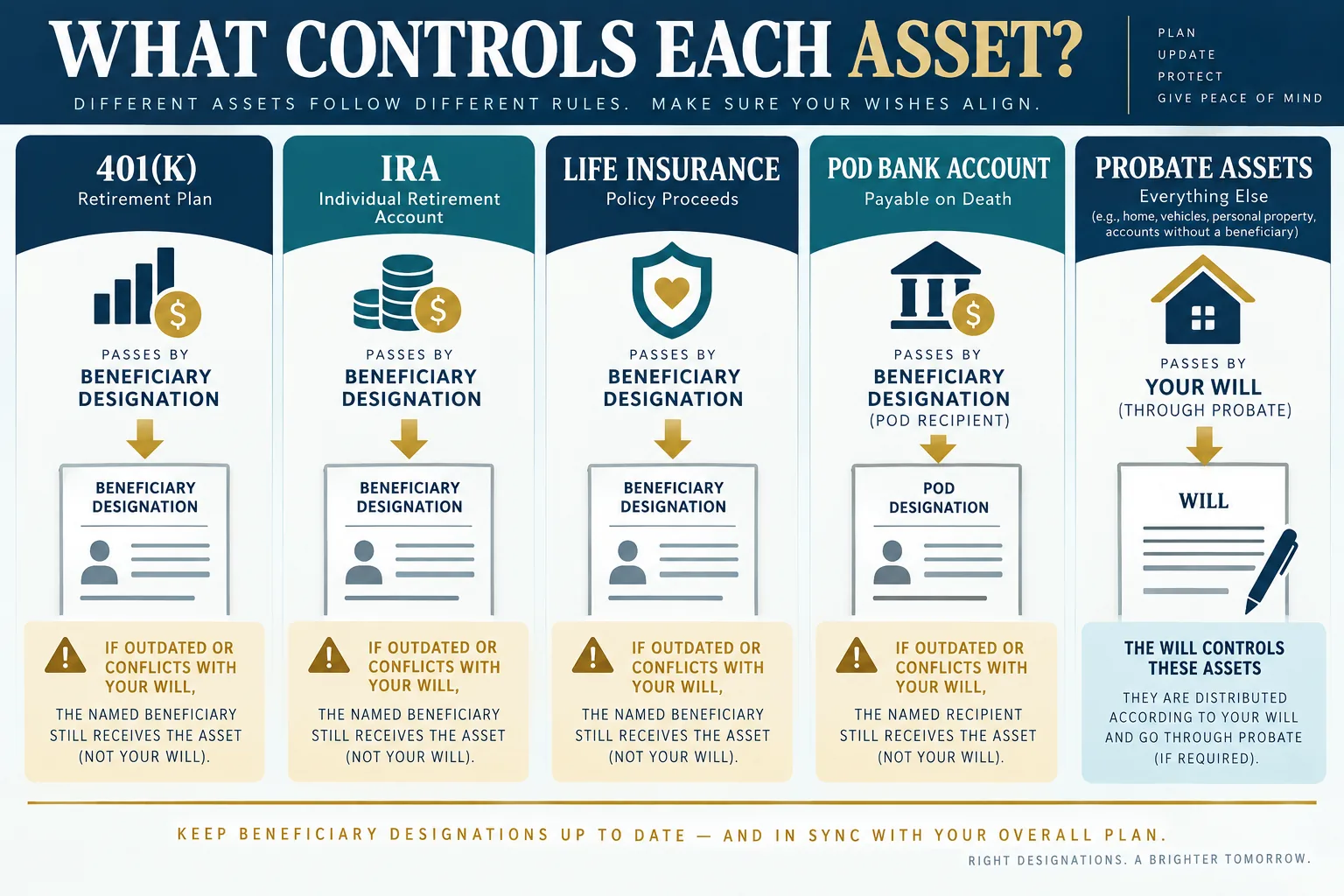
A beautifully drafted will cannot redirect every dollar you own. Retirement plans, IRAs, life insurance and payable-on-death accounts commonly move under their own beneficiary instructions, while assets titled only in your name may pass through probate under a will or state law.
- Inventory assets by transfer method, not just by institution.
- Compare every primary and contingent beneficiary with the estate plan after major life events.
- Do not change a spouse’s employer-plan beneficiary without checking consent rules.
Two transfer systems operate at the same time
A will controls property that becomes part of the probate estate, subject to state law and valid ownership arrangements. It usually does not rewrite a contract that promises an account or policy directly to a named beneficiary.
IRS regulations say a retirement-plan beneficiary is determined under the plan; receiving an interest under a will or state law does not by itself make that person the plan’s designated beneficiary. The plan document and accepted election are therefore the first evidence to obtain.
Map each asset to its controlling instruction
List employer plans, IRAs, annuities, life insurance, transfer-on-death securities, payable-on-death bank accounts, jointly owned property, trusts and individually titled assets. For each item, record the owner, primary beneficiary, contingent beneficiary and what happens if all named people die first.
Do not assume all products at one institution behave alike. A checking account may have a payable-on-death instruction, an IRA a separate designation, and a taxable brokerage account no transfer-on-death registration at all.
Spouse rights can override a casual form change
Department of Labor guidance notes that some employer retirement plans protect a spouse as beneficiary and require witnessed spousal consent to select someone else. A person who named a sibling while single should not assume that old election remains decisive after marriage.
IRAs and life insurance follow different contracts and state-law overlays. Ask the administrator or carrier for the current rules and accepted form rather than copying advice written for a 401(k).
Why outdated forms create expensive surprises
Divorce, remarriage, birth, death, estrangement, adoption and a job change can make yesterday’s form inconsistent with today’s intent. A former spouse, deceased beneficiary, minor child or estate named by default can create litigation, delays, guardianship questions or less favorable retirement distribution options.
A will signed later may express a different wish without changing the account record. Never rely on a handwritten list in a desk drawer when the institution requires an authenticated online or paper designation.
Use primary and contingent beneficiaries deliberately
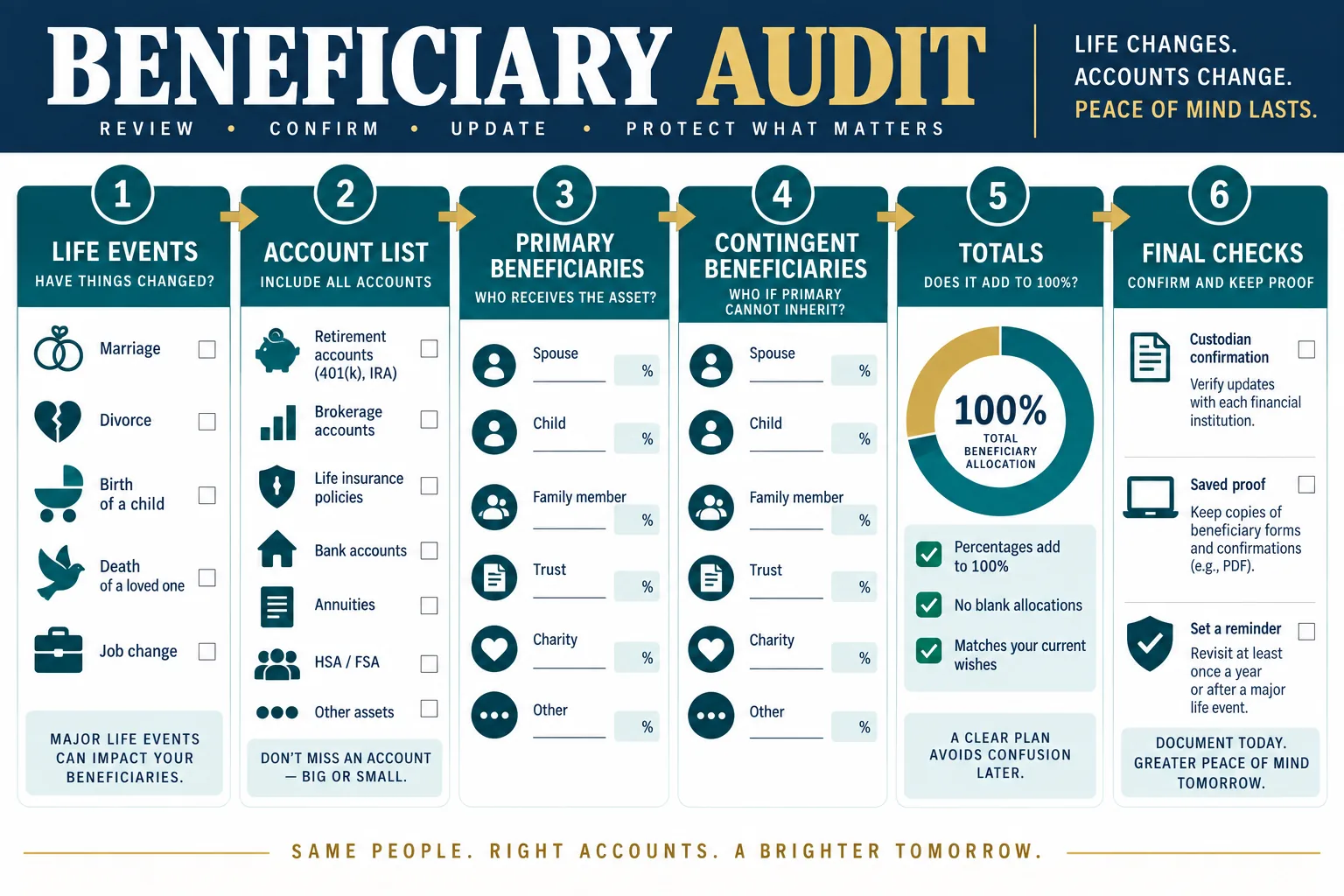
Primary beneficiaries receive first; contingent beneficiaries generally step in only if no primary beneficiary can take. Percentages should total exactly 100%, and “per stirpes” or similar language should be used only after understanding the provider’s definition and state-law effect.
Naming a trust or estate can be appropriate but changes administration and tax questions. IRS rules for inherited retirement accounts depend on the beneficiary’s identity, relationship and other characteristics, so tax and estate-planning advice may be worth the cost.
Run an annual beneficiary audit
Download or request confirmation directly from every custodian, plan administrator and insurer. Compare the confirmation—not merely the form you submitted—with your current legal names, relationships, percentages and successor choices.
Store confirmations with the estate plan, but protect account numbers and personal data. Tell the executor or a trusted person where the inventory is located without sharing passwords or making them a joint owner merely for convenience.
A blended-family example
Imagine a parent remarries, updates a will so two children inherit equally, but leaves a former spouse on a $300,000 employer plan and names the new spouse on a payable-on-death savings account. The will’s equal split may apply only to probate assets, not those two contracts.
The solution is not to assume who “deserves” the money after death. While competent, the owner should coordinate the will, marital rights, plan forms, account titles and tax consequences, then obtain written confirmations.
Action checklist
Review after marriage, divorce, birth, death, disability, a move, job change and every annual financial checkup. Verify primary and contingent names, percentages, successor provisions, spouse consent, trust language, custodian acceptance and a secure record of confirmation.
This is general education, not legal or tax advice. Probate, marital-property, divorce and trust rules vary by state and contract; use a qualified attorney for blended families, special-needs planning, creditor concerns or large retirement accounts.
Questions families overlook
What happens when no valid beneficiary survives? The contract’s default order may send money to a spouse, children or the estate, and the answer can differ across accounts. Ask each institution for its default-beneficiary provision instead of assuming state intestacy law supplies the same result.
Minors present a separate problem. Naming a child directly may require a court-supervised guardian or restricted account before funds can be managed; a properly designed trust or custodial arrangement may fit better, but wording and age limits require state-specific advice.
After a divorce, do not assume a decree or state revocation statute automatically changes every designation. Employer plans can be governed by federal law, and a qualified domestic relations order may affect benefits. Deliver required orders and new elections to the administrator and obtain confirmation.
Digital convenience creates another trap: a profile screen may display a beneficiary while an incomplete signature, missing spouse waiver or rejected upload prevents acceptance. Save the final confirmation date and repeat the check after a provider merger, plan conversion or rollover.
Final verification before closing the file
Finish with a signed estate-planning summary that lists who should receive each category and which instrument carries out that wish. The summary is not itself a beneficiary form, but it helps the attorney, owner and institutions find contradictions while the owner can still correct them.
Important: This guide provides general educational information. Verify current rules, deadlines, contracts and professional advice for your facts.
- IRS retirement beneficiary guidance
- U.S. Department of Labor ERISA FAQs
- IRS beneficiary designation regulations
Reviewed September 20, 2026.