


A denial is not one thing. “Not covered,” “not medically necessary,” “late notice,” “excluded cause,” “insufficient proof” and “below the deductible” require different responses—and an appeal that never addresses the stated reason is easy to reject again.
- Identify the policy type, exact denial reason, clause and deadline before collecting evidence.
- Build a numbered packet that connects each fact to a coverage term.
- Escalation routes differ for health, home, auto, employer and government plans.
Classify the policy before appealing
Determine whether the claim involves health, homeowners, renters, auto, disability, life, travel or another contract. For health coverage, identify whether the plan is fully insured, self-funded employer coverage, Medicare, Medicaid or Marketplace because the reviewer and law can differ.
Locate the declarations, policy, endorsements, summary plan description and denial notice. Marketing summaries are not a substitute for the governing contract.
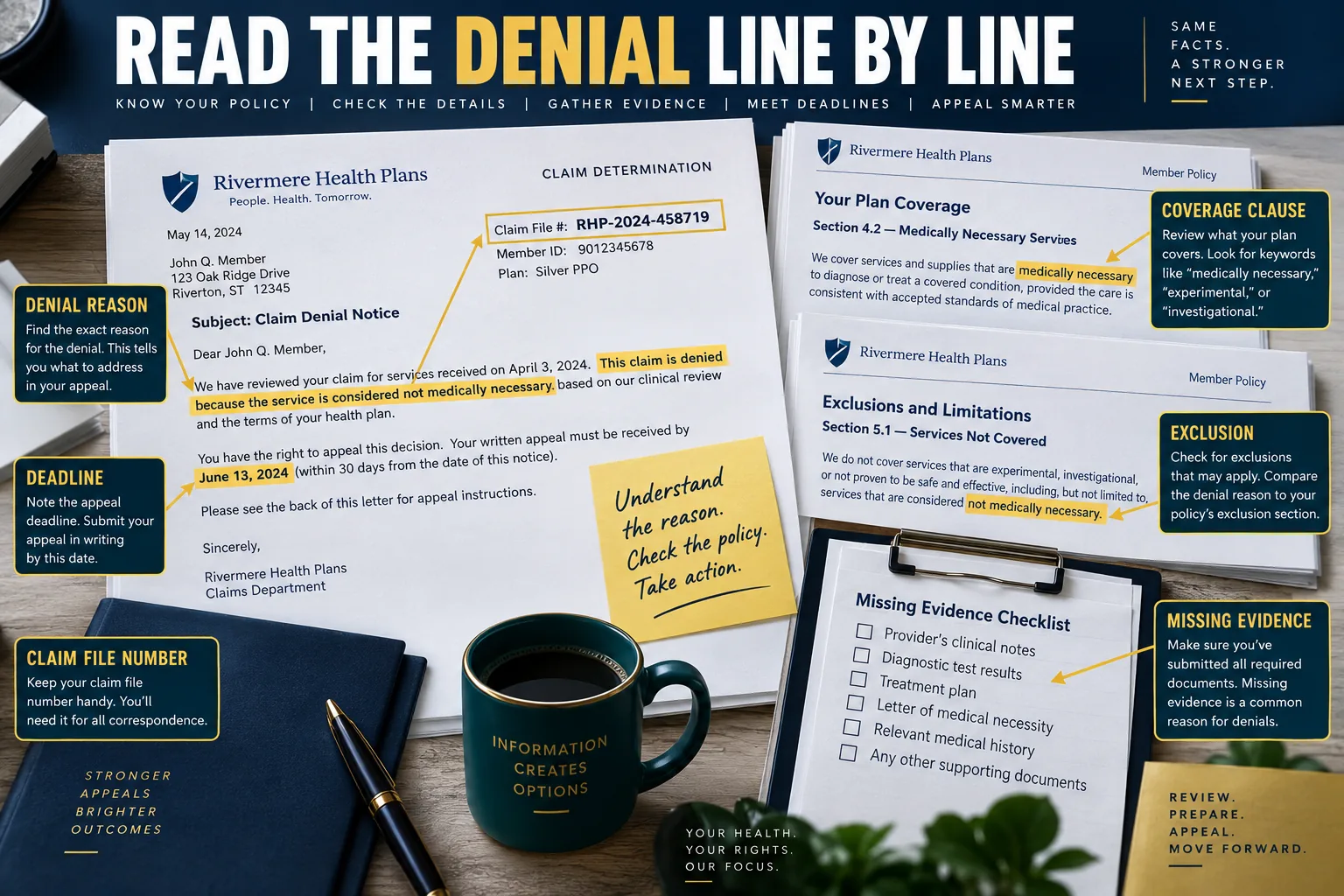
Decode the denial line by line
Write down the stated reason, cited clause, facts the insurer accepted, facts it disputes, missing materials, appeal address and deadline. Ask for the complete claim file or records you are entitled to receive under the applicable process.
Separate a coverage denial from a valuation disagreement. An insurer may accept that a loss is covered but dispute repair scope, depreciation or price; the evidence and escalation path are different.
Build a one-page timeline
List the triggering event, notice, inspections, treatment or repairs, submissions, calls, payments and denial. Attach claim numbers and representative names, but keep argument out of the chronology.
A clean timeline exposes misunderstandings such as an adjuster using the wrong loss date, a medical reviewer missing a prior treatment, or documents arriving after the first decision.
Match evidence to the reason
For a property claim, use dated photos, inventories, maintenance records, licensed estimates and expert causation opinions. For health coverage, use clinical notes, guidelines, prior treatments and a clinician’s explanation of medical necessity.
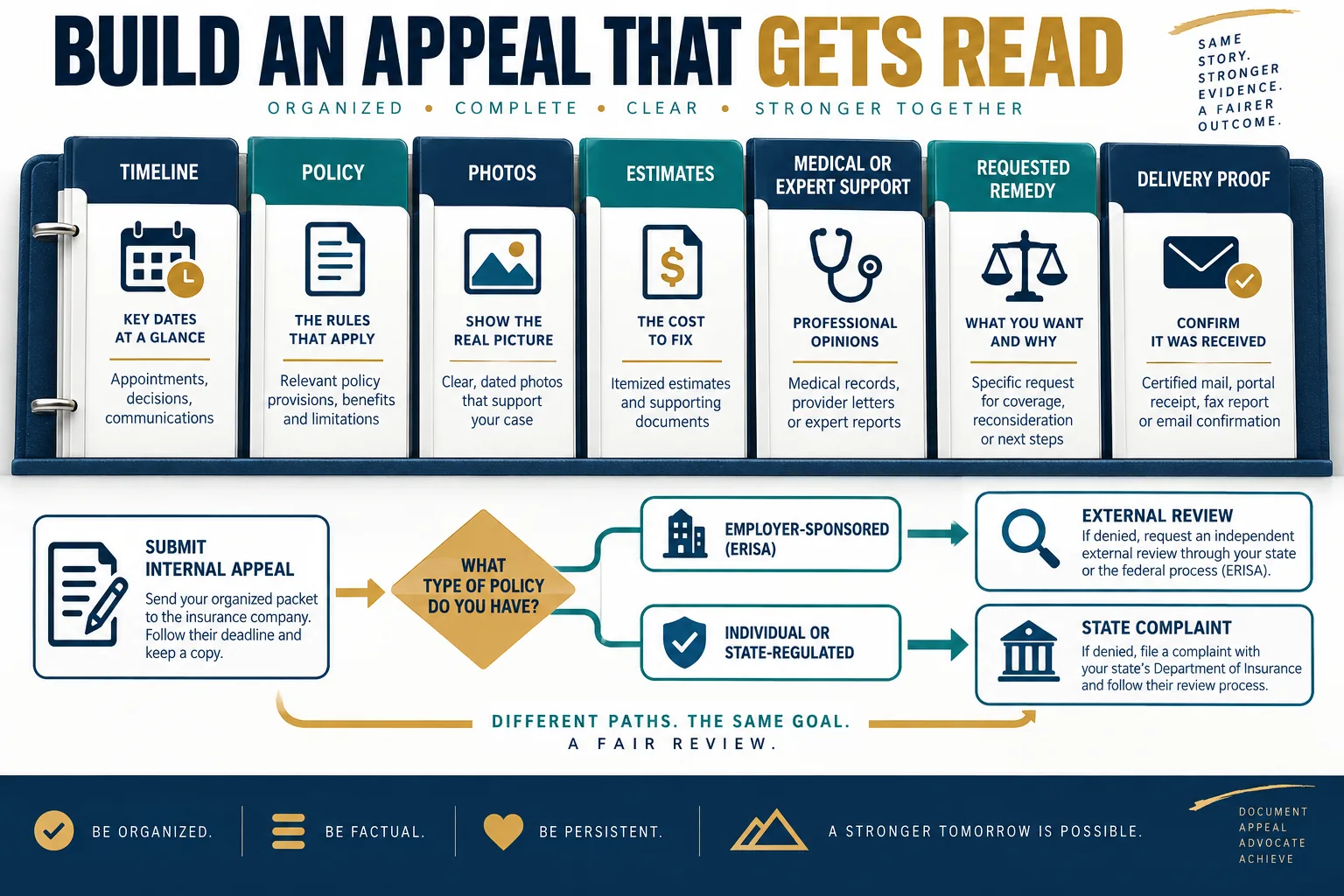
More pages are not automatically better. Create a numbered index and state what each exhibit proves about the disputed policy term.
Write a decision-ready appeal
Open with the requested result, denial date and deadline. Quote the relevant clause accurately, state the insurer’s reason, respond point by point, cite exhibits and request a written explanation addressing every issue.
Avoid accusations you cannot prove. A focused packet lets a new reviewer reverse the decision without reconstructing the claim from scattered emails.
Health claims have a distinct review route
HealthCare.gov explains that covered health-plan denials generally begin with an internal appeal and may proceed to independent external review. Denials involving medical judgment, experimental treatment or certain rescissions can qualify.
The listed federal external-review deadline is generally four months after the final denial, but plan and state instructions control. Urgent cases can use expedited procedures; do not wait for a standard timeline when delay threatens life or function.
Property and other claims use state routes
For home or auto claims, follow the policy’s appraisal, proof-of-loss and suit-limitation provisions and your state insurance department’s guidance. NAIC’s complaint tool routes consumers to the state regulator for unfair delays or denials.
A regulator may investigate handling but may not act as your private lawyer or determine every factual dispute. Large claims, looming deadlines or complex causation may justify licensed professional advice.
Appeal checklist
Calendar every deadline; obtain the full contract and denial; classify the dispute; build a timeline; gather targeted evidence; calculate the requested remedy; submit through the required channel; preserve delivery proof; and schedule follow-up.
This is general information. Policy language, state law, ERISA, Medicare and other programs can materially change rights and deadlines.
Worked examples and common mistakes
A homeowners denial stating “long-term seepage” will not be answered by proving only that the floor is wet. The appeal needs evidence about source and duration: a plumber’s findings, dated photographs, water-usage data, prior inspection history and the policy language governing sudden versus repeated leakage.
A health denial for lack of medical necessity requires a different packet. The clinician should connect symptoms, failed alternatives, guidelines and the requested service to the plan’s criteria; invoices and emotional hardship alone do not establish medical necessity.
Common mistakes include missing the appeal deadline while negotiating by phone, submitting original documents, arguing from fairness without quoting coverage, adding unsupported accusations and demanding an amount with no calculation. Another is using a state complaint when the notice requires a plan appeal first.
Before accepting a partial payment or signing a release, ask what claim elements remain open. Preserve undisputed payments separately from the appeal and avoid duplicate recovery. If litigation or contractual limitation periods may expire, do not assume an internal complaint pauses them.
Final verification before closing the file
Create a final cover sheet with seven fields: policyholder, policy number, claim number, loss or service date, denial date, appeal deadline and requested result. Add a table of exhibits and page numbers. This simple structure prevents identifying information and the remedy from disappearing inside a long narrative, and it makes follow-up calls far more precise. Keep a dated call log recording the representative, reference number, promise made and next follow-up date.
Important: This guide provides general educational information. Verify current rules, deadlines, contracts and professional advice for your facts.
- HealthCare.gov insurance decision appeals
- HealthCare.gov external review
- NAIC insurance complaint guide
Reviewed September 20, 2026.