


The question Americans ask most about gifting is simple: “If I give my child money, stock, or a house, will either of us owe tax?” In most ordinary cases, the recipient does not pay federal income tax merely for receiving a gift—and even a donor who gives more than $19,000 may only need to file a return, not write a check.
The $19,000 rule—what it actually means
The exclusion is measured per donor, per recipient, per calendar year. A parent could give $19,000 to each of three adult children in 2026 without using the parent’s lifetime exemption, assuming each gift is a qualifying present interest. It is not a total family limit, and the recipient generally does not report the gift as ordinary income.
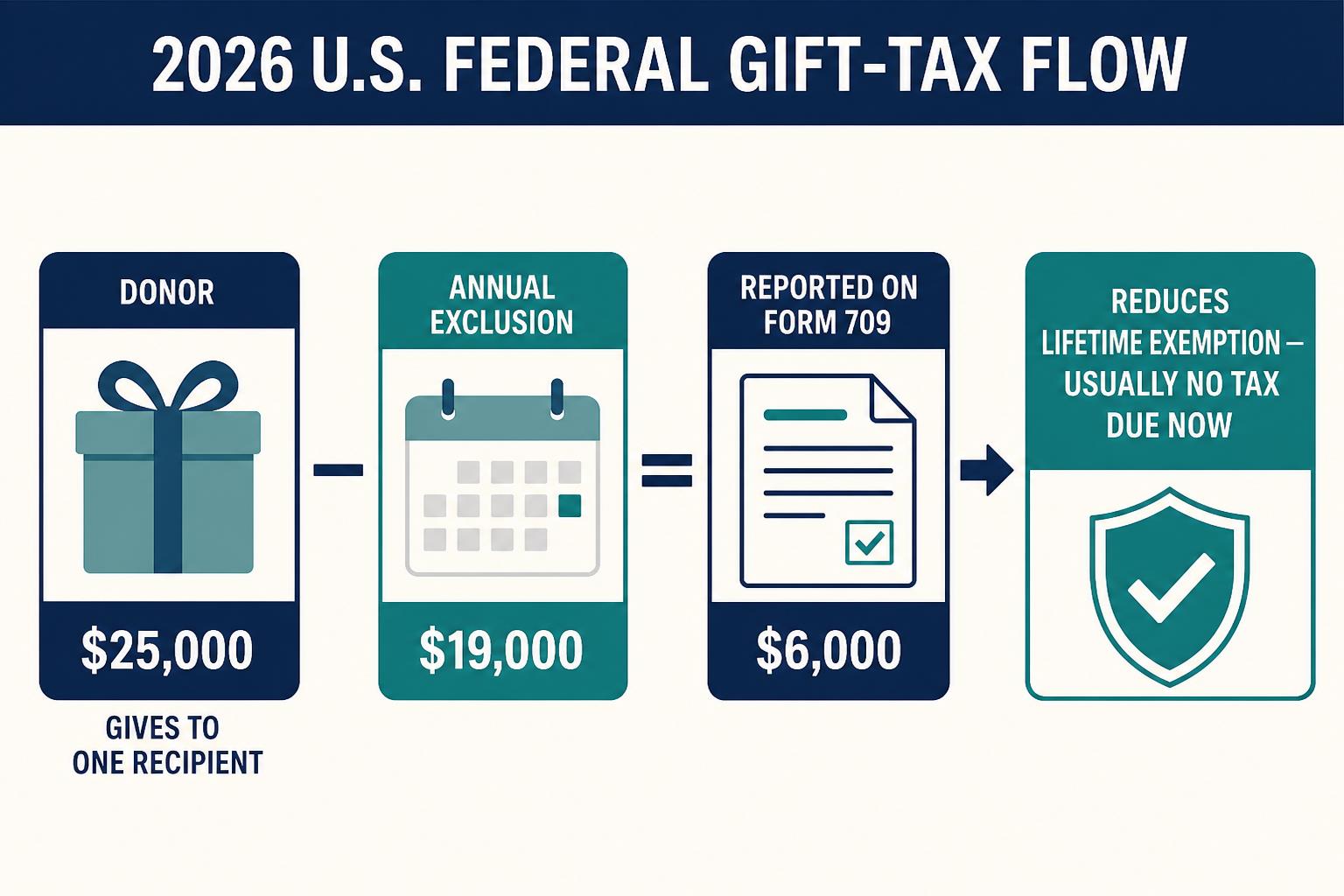
If one donor gives one child $25,000, the first $19,000 is covered by the annual exclusion. The remaining $6,000 is generally a reportable taxable gift. “Taxable gift” here does not necessarily mean tax is currently payable: it normally reduces the donor’s remaining lifetime estate-and-gift exemption. The IRS says the 2026 basic exclusion amount is $15 million.
Who files and who pays?
The donor is generally responsible for federal gift-tax reporting and any gift tax. A recipient usually does not file Form 709 simply for receiving the property. A reportable 2026 gift is generally disclosed on Form 709 by April 15, 2027, subject to applicable extension rules.
| Situation | Likely federal treatment |
|---|---|
| $10,000 cash to an adult child | Within the 2026 annual exclusion; generally no Form 709 for this gift alone. |
| $25,000 cash to one child | Generally report $6,000 above the exclusion; it usually reduces the lifetime exemption. |
| $19,000 each to four people | Each recipient has a separate exclusion. |
| Parents jointly give $38,000 | Potentially covered by two exclusions; ownership and gift-splitting documentation matter. |
The bigger trap: giving appreciated stock or a home
For many middle-class families, gift tax is not the largest cost. Capital-gains basis is. A recipient of appreciated property generally receives the donor’s carryover basis for calculating gain, subject to special rules. If Mom bought shares for $20,000 and gives them when they are worth $100,000, the child may inherit the old $20,000 basis and face substantial gain when selling.
Inherited property, by contrast, generally receives a basis tied to fair market value at death. That does not automatically make waiting the right choice—Medicaid planning, creditor risk, control of the asset, state tax, and estate goals also matter—but it makes casually transferring a deed or long-held stock a decision worth modeling first.

Gifts that can receive special treatment
- Tuition: qualifying tuition paid directly to the educational institution can be excluded; money handed to the student for tuition is not the same transaction.
- Medical expenses: qualifying expenses paid directly to the medical provider can receive an exclusion.
- Spouses: gifts to a U.S.-citizen spouse are generally covered by the marital deduction; gifts to a noncitizen spouse have a separate annual limit.
- Charity: qualifying charitable gifts follow different deduction and substantiation rules.
Before transferring money, stock, or real estate
- Add every gift made to the same recipient during the calendar year.
- Record the date, fair market value, and how the value was determined.
- For stock or property, preserve the donor’s purchase and improvement records.
- Check whether Form 709 is required—even when no tax is due.
- For a deed, business interest, trust, foreign gift, or noncitizen spouse, consult a qualified tax or estate-planning professional before signing.
Quick FAQ
Does the recipient pay income tax on cash from a parent?
Generally no, simply receiving a genuine gift is not federal taxable income. Income later produced by the gifted asset can be taxable.
Can I give $19,000 in December and another $19,000 in January?
Potentially yes, because the annual exclusion resets by calendar year, assuming each transfer qualifies.
Can I deduct a family gift on my income-tax return?
No. Personal gifts are generally not deductible; qualifying charitable contributions are different.
Where can I verify the rules?
Read the IRS Gift Tax FAQs, Form 709 information, and Publication 551 on basis.
This article provides general education, not individualized tax, legal, Medicaid, or estate-planning advice.