


A renewal offer is not always a final price, but “the increase feels unfair” is rarely the strongest argument. A tenant has more leverage when the request is early, specific and supported by comparable units, a reliable payment history and a low-friction alternative the owner can accept.
- Read the lease and local notice rules before negotiating; deadlines control your options.
- Compare truly similar available units and calculate the full cost of staying versus moving.
- Offer two or three packages—rent, term and concessions—rather than one ultimatum.
Check the lease, notice and local law first
Find the renewal-notice deadline, automatic-renewal clause, month-to-month terms, required delivery method and fees. State and local laws differ on rent caps, notice periods, retaliation, discrimination and the rights attached to subsidized or regulated housing.
USAGov directs renters to state tenant-rights agencies and legal-aid resources because there is no single national rent-renewal rule. Negotiation cannot waive protections that law makes nonwaivable, and a tenant should not threaten legal claims without understanding them.
Separate a lawful market negotiation from a repair or safety dispute. Put unresolved habitability issues in writing, preserve photographs and requests, and seek local tenant assistance when needed instead of trading away essential repairs for a temporary rent concession.
Build a fair market comparison
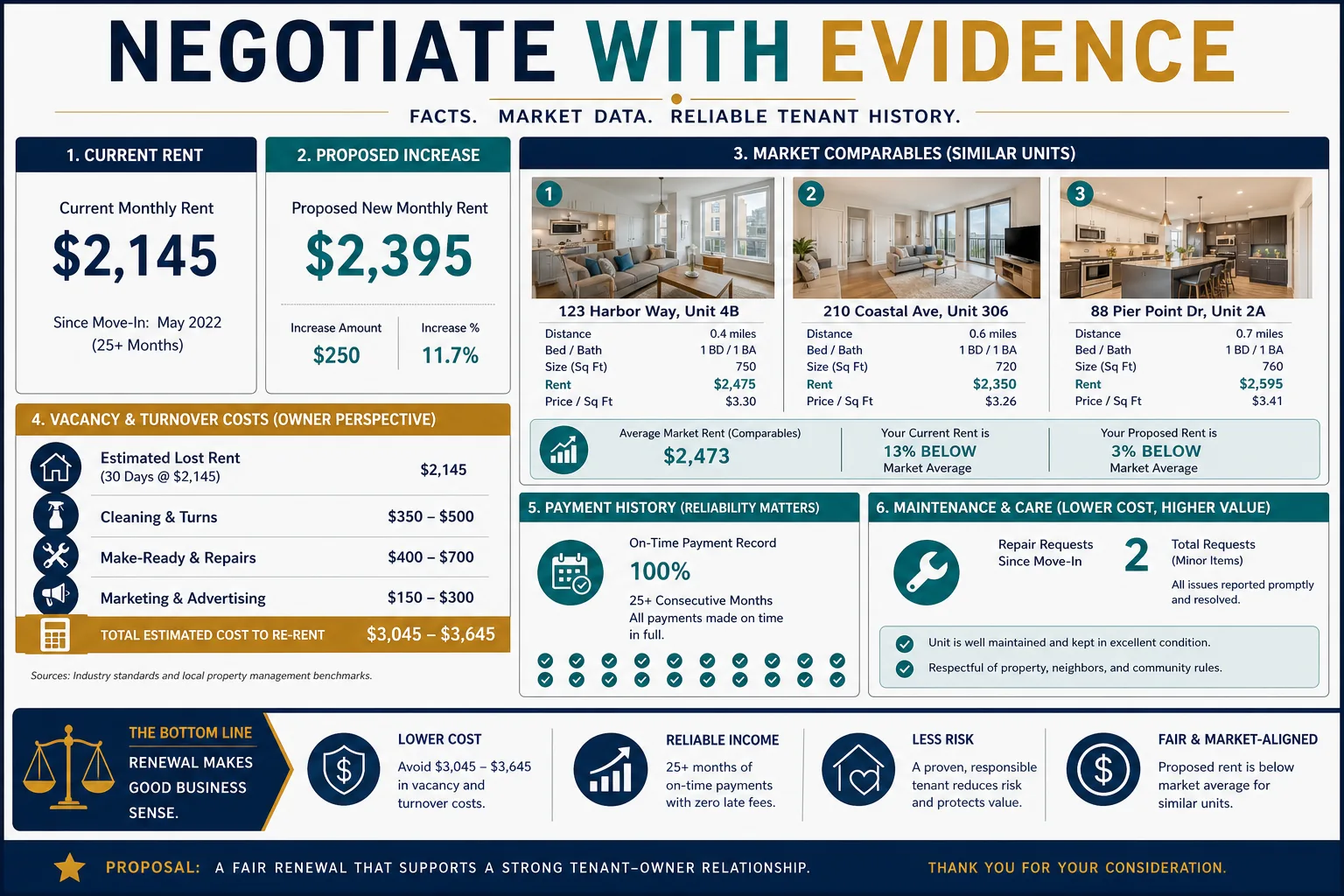
Collect three to five current or recently leased units with the same neighborhood, bedroom count, approximate size, condition, amenities, parking, pet policy and utility arrangement. Save dated screenshots because advertised rent and availability can change.
Adjust honestly. A renovated unit with in-unit laundry and free parking is not a clean comparison for an older apartment without those benefits; conversely, a teaser rate tied to one free month should be converted to an effective annual rent.
Calculate the real cost of moving
Compare twelve-month totals, not only the monthly increase. Moving can involve application fees, deposits, movers, utility setup, overlapping rent, cleaning, time off work and the risk of a higher renewal at the next property.
Suppose the proposed increase is $150 per month, or $1,800 a year. If moving costs $2,400 and the alternative saves only $100 per month, the first-year cash advantage may disappear; that math supports negotiating, but it does not make the landlord responsible for your moving cost.
Translate your history into owner value
Document on-time payments, lease compliance, careful upkeep, prompt reporting of leaks or hazards and a desire to remain. A known reliable tenant can reduce vacancy, cleaning, marketing and screening costs, although those savings vary and should not be exaggerated.
Avoid oversharing hardship as the only argument. Pair any personal context with a business proposal: a longer term, earlier signature, flexible renewal date or another condition that provides predictable occupancy.
Offer packages instead of one demand
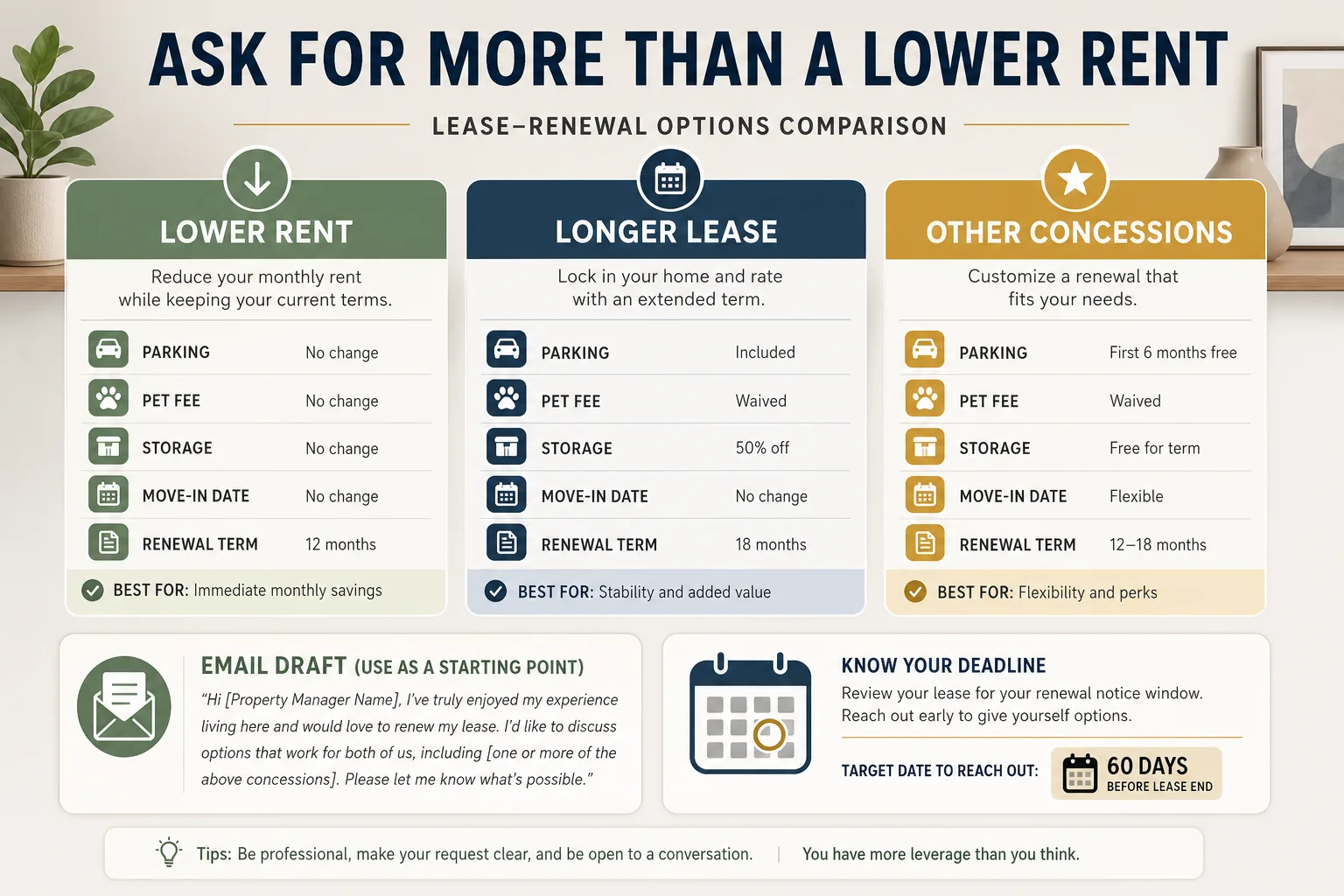
Package A might request a smaller increase for a 12-month renewal. Package B might accept the proposed rent for an 18-month rate lock; Package C might accept more rent if parking, storage, a pet fee, repainting or another valuable concession is included.
Concessions can be easier than changing headline rent, especially in larger properties with pricing systems. Calculate their dollar value and confirm every promise in the final written lease rather than relying on a phone call.
Use a concise professional script
Try: “I’ve enjoyed living here and would like to renew. The proposed rent is $X; three comparable units with similar size and amenities are listed around $Y–$Z. I have paid on time for N months and maintained the apartment. Would you consider $A for 12 months, or $B with an 18-month rate lock and parking included?”
Ask an open question—“What flexibility do you have?”—and give a reasonable response deadline. Do not bluff about moving or competing offers; be prepared to follow through if the final number exceeds your budget.
A negotiation example with three packages
Suppose rent is $2,100 and the renewal offer is $2,300. Similar units range from $2,180 to $2,250, the tenant has paid on time for three years, and moving would cost roughly $2,500.
Instead of demanding $2,100, the tenant offers $2,200 for 12 months; $2,225 for 18 months with no additional increase; or $2,300 with parking worth $100 monthly included. The first two packages use market evidence, while the third preserves the owner’s advertised rent but changes total value.
If management counters at $2,250 for 12 months, the tenant compares the $1,800 annual increase with moving costs and the quality of alternatives. Accepting can be rational even without “winning” the opening number; negotiation is about improving the available choice, not proving the landlord wrong.
Close the agreement safely
Read the entire new lease, not just the rent line. Verify term, renewal date, utilities, parking, pets, deposits, late fees, notice requirements, concessions and any waiver language; save the signed document and proof of payment.
Checklist: calendar notice dates; check local rights; collect comparable units; calculate effective rents and moving costs; document tenant history; choose target and walk-away numbers; send two or three packages; follow up in writing; inspect the final lease; and retain all correspondence.
Important: This guide provides general educational information. Property, travel, retirement, insurance and tenant rules can vary by location, plan, policy and individual facts; verify current official instructions before acting.
- USAGov tenant-rights and state-help directory
- HUD tenant-rights resources
- Legal Services Corporation legal-aid finder
Reviewed August 18, 2026.