


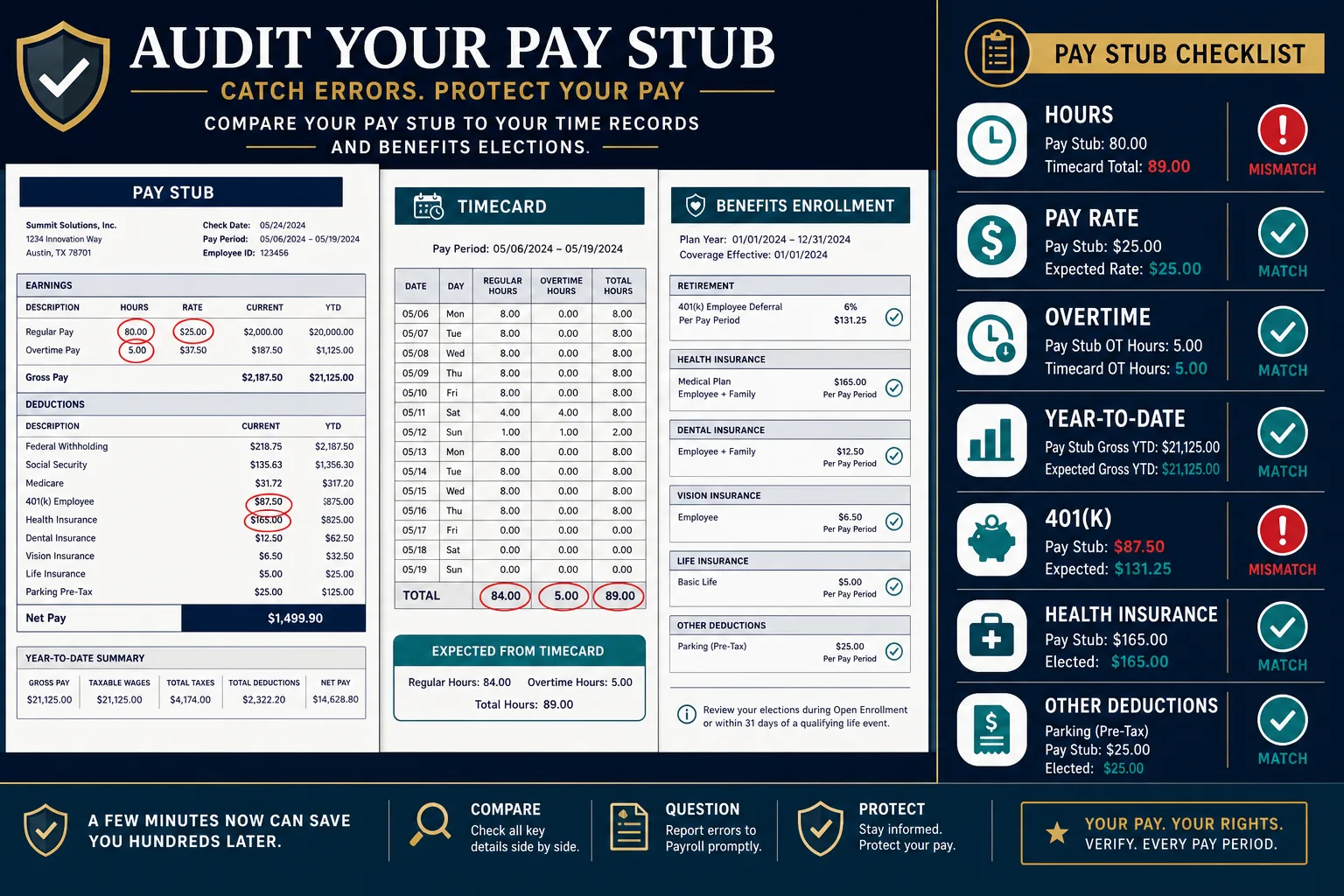
A pay stub is a reconciliation statement: time and rate create gross pay, tax and benefit rules create deductions, and what remains becomes net pay. Reading it every payday is the fastest way to catch a payroll error while schedules, approvals and enrollment records are still available.
- Reconcile hours, rate and overtime before examining taxes.
- Compare current deductions with year-to-date totals and your benefit elections.
- In 2026, the employee Social Security rate is 6.2% up to the wage base and Medicare is generally 1.45%, with additional Medicare withholding rules at higher wages.
Identify the pay period and basis
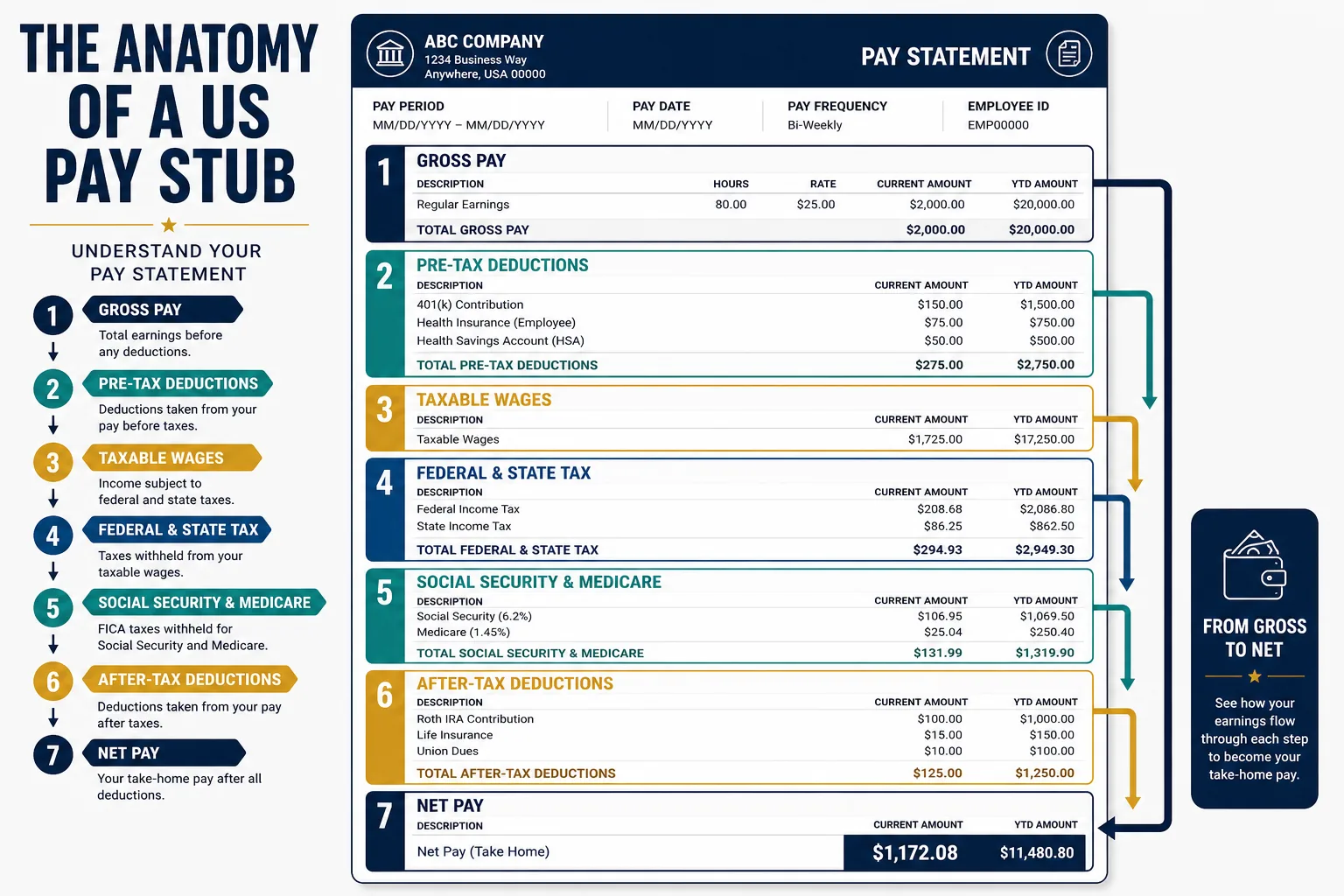
Find the period start and end, pay date, employer, employee ID and pay frequency. A pay date can fall after the work period, so compare the stub with the correct timecard—not merely this week’s calendar.
Confirm whether you are hourly, salaried, piece-rate or commission-based and whether multiple rates appear. Department of Labor recordkeeping rules require covered employers to maintain core hours, earnings, additions and deduction records, although the layout and pay-statement rules vary by state.
Recalculate gross pay
For an hourly worker, multiply regular hours by rate, then add overtime, shift differentials, bonuses and other earnings. For a salaried worker, divide annual salary by the employer’s pay periods, while remembering that unpaid leave or midperiod changes can alter the result.
Do not assume every bonus has the same withholding pattern as regular wages. First verify that total gross earnings match the employer’s stated components.
Separate pre-tax from after-tax deductions
Health premiums, traditional 401(k) contributions, flexible spending and health savings contributions may reduce particular taxable wage bases, but not always in the same way. A deduction can reduce federal income-tax wages without reducing Social Security or Medicare wages.
Roth retirement contributions are generally after-tax for federal income-tax purposes. Compare the stub with the enrollment confirmation and plan percentage, including employer match—which is valuable but usually is not part of take-home pay.
Read federal, state and payroll taxes
Federal income-tax withholding depends on earnings, pay frequency and Form W-4 information; it is a prepayment, not the final annual tax. State and local withholding depends on where you live and work.
For 2026, IRS guidance lists the employee Social Security rate at 6.2% up to the $184,500 wage base and Medicare at 1.45%. Employers begin withholding an additional 0.9% Medicare tax after paying an employee more than $200,000 in wages during the year; the employee’s ultimate tax can depend on filing status.
Reconcile net pay and deposit
The basic bridge is gross pay minus taxes and deductions plus reimbursements equals net pay. Reimbursements may be nonwage payments, so do not force every deposit line into taxable earnings.
Confirm the net amount matches bank deposits and that split deposits went to the right accounts. A penny-level rounding difference can be normal; a missing account or repeated deduction is not.
Use year-to-date totals as an alarm
Year-to-date columns help reveal a deduction that silently doubled, a retirement contribution approaching its annual limit, or taxable wages that do not track gross pay as expected. Compare the current stub with the prior one after raises, benefit elections, bonuses or leave.
Also check paid-time-off balances cautiously: some systems update on a different cadence. Ask payroll what the field represents before assuming hours vanished.
Worked paycheck example
Suppose 80 regular hours at $25 produce $2,000, plus five overtime hours at $37.50 produce $187.50, for $2,187.50 gross. A $150 qualifying pre-tax health deduction and $131.25 traditional retirement contribution may change one or more taxable bases.
Federal and state withholding then depend on elections and jurisdiction, while Social Security and Medicare use their applicable wage bases. The correct audit is not “net should equal 70% of gross”; it is a line-by-line reconciliation using the stub’s taxable-wage fields.
What to question immediately
Flag missing hours, wrong rate, unpaid overtime, duplicate insurance, deductions you never authorized, an incorrect work state, unexpected garnishment or a year-to-date total that moves backward. Save the stub, timecard, schedule and benefit election before systems update.
Report the mismatch in writing to payroll with the pay period and exact line. If wages remain unpaid, consult the relevant state labor agency or the U.S. Department of Labor; do not email sensitive identity documents to an unverified address.
Frequently missed pay-stub clues
Take-home can fall after a raise because benefit deductions, percentage-based retirement contributions, withholding or a prior correction changed. A raise does not cause every dollar to be taxed at a higher bracket.
Federal taxable wages may be below gross wages because some pre-tax benefits reduce that base. Compare federal, Social Security and Medicare wage fields separately because exclusions can differ.
If overtime looks wrong, confirm the workweek, regular rate and compensation included in that rate. Overtime rules are more detailed than multiplying the displayed base rate in every case, and exemptions depend on duties and legal tests.
Keep final stubs, W-2 forms, time records, benefit elections and correction emails securely. At year-end, reconcile cumulative wages and withholding with the W-2 promptly so an incorrect form can be fixed before filing.
Build a record that survives follow-up
Treat each major employment change as a trigger for a deeper review: first paycheck, raise, bonus, promotion, new work state, marriage, benefit enrollment and retirement-percentage change. Use the IRS withholding estimator when circumstances change, then submit a new W-4 if appropriate; the payroll department can implement elections but should not choose your tax position for you.
Important: This guide is general educational information, not legal, tax, insurance or medical advice. Rules, contracts and individual facts vary; verify current official instructions before acting.
- U.S. Department of Labor wage recordkeeping
- IRS tax withholding
- IRS Topic 751: Social Security and Medicare withholding
Reviewed August 21, 2026.