

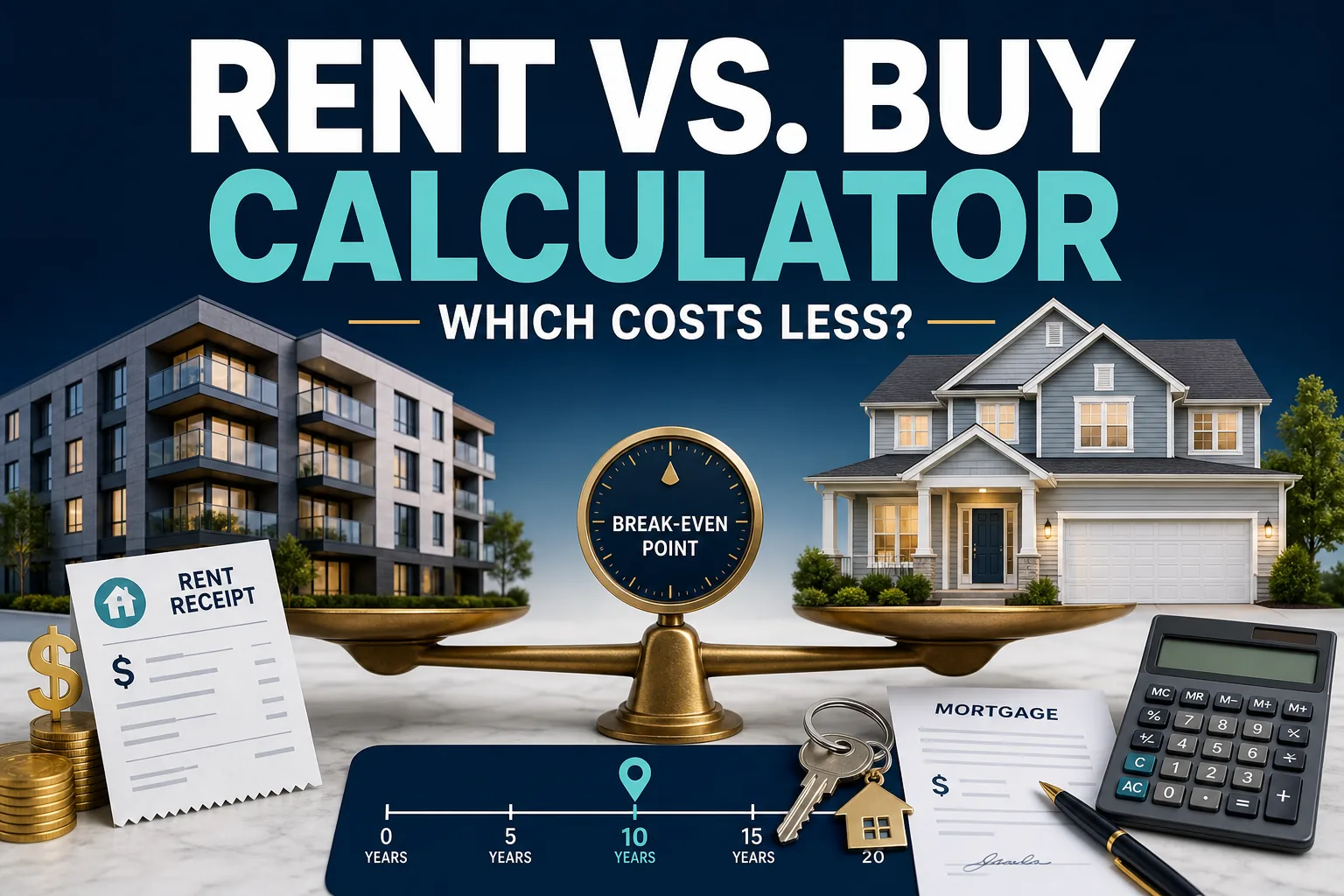
Is buying really better than renting? This calculator compares both choices as complete financial strategies—including the cash tied up at closing, mortgage amortization, ownership costs, rent increases, home appreciation, selling costs, and the investment return a renter could earn.
Rent vs. Buy Calculator
Use local estimates and test more than one scenario.
Projected advantage by year
Positive bars favor buying; negative bars favor renting.
What the calculator is actually comparing
Buying converts part of each mortgage payment into equity, but it also requires a down payment and closing costs that could otherwise remain invested. The model estimates the home’s future value, subtracts the remaining mortgage and selling costs, and adds any monthly savings the buyer could invest when owning costs less than renting.
The renting strategy begins by investing the cash that would have been used for the down payment and closing. It then invests any month in which rent and renter’s insurance cost less than ownership, so the comparison does not pretend the renter simply spends the initial cash.
Costs included—and important costs excluded
Ownership includes principal and interest, property tax, homeowners insurance, HOA dues, maintenance and estimated PMI. Rent includes the entered monthly payment, annual rent growth and renter’s insurance; both strategies use your chosen investment return, while the buying result deducts estimated selling costs.
The calculator deliberately excludes federal and state tax benefits, utilities, moving costs, renovations, special assessments, transaction-specific fees and differences in home size or quality. Mortgage interest is not automatically a dollar-for-dollar tax saving: federal deductibility generally requires itemizing and is subject to IRS rules and limits.
How to choose realistic assumptions
Use the interest rate and cash-to-close figures from an actual Loan Estimate, not a national mortgage-rate headline. Enter the local property-tax rate, a real insurance quote, likely HOA dues, and a maintenance allowance appropriate to the property’s age and condition.
Run a conservative case as well as an optimistic one. A useful stress test might lower appreciation, raise maintenance, shorten the holding period and increase selling costs; if buying only wins under the rosiest assumptions, the decision is financially fragile.
Why the time horizon changes everything
Closing and selling costs are concentrated at the beginning and end of ownership, while mortgage principal reduction builds gradually. A buyer who moves after two or three years may not have enough appreciation or amortization to overcome those costs, even when the monthly payment looks competitive.
Renting also buys flexibility. If a likely job change, family transition or relocation makes the holding period uncertain, compare a short horizon honestly rather than entering the number of years needed to make buying win.
Frequently asked questions
Does a lower monthly mortgage payment mean buying wins?
No. Add taxes, insurance, maintenance, HOA dues, PMI and transaction costs, then account for the down payment’s opportunity cost.
Does the calculator predict home prices or investment returns?
No. Appreciation, rent growth and market returns are user assumptions, not forecasts. Test several combinations.
Why is principal included in the monthly cost if it builds equity?
The cash leaves the household each month, but the model also credits the resulting equity through the declining mortgage balance. This prevents principal from disappearing from the final wealth comparison.
Should I buy whenever the result favors buying?
Not necessarily. Emergency reserves, income stability, repair risk, location, mobility and quality of life can outweigh a modeled financial advantage.
Educational estimate: Results are hypothetical and depend on your inputs. This tool does not provide mortgage, investment, tax, legal or real-estate advice, and it does not guarantee future home values, rents or returns.