

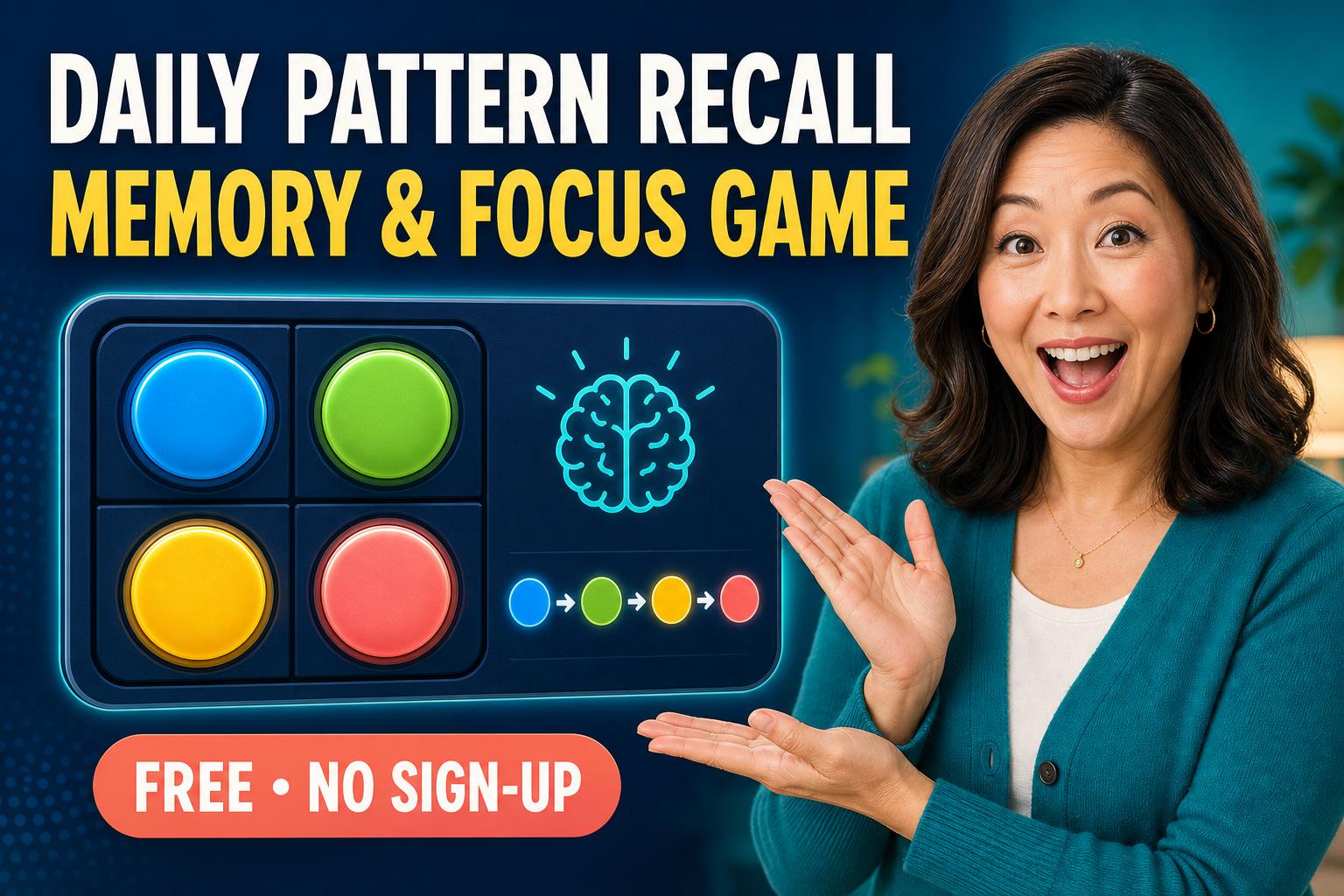
Watch the colored sequence, then repeat it in the same order. Daily Pattern Recall is a free, low-pressure attention and working-memory exercise with large controls, an optional slower pace, and no account required.
Daily Pattern Recall
How to play
- Choose a relaxed or regular pace, then press Start game.
- Watch and listen as the pads light up. Each color also has a unique shape, so the game does not rely on color alone.
- When “Your turn” appears, repeat the sequence.
- Each successful round adds one step. If you make a mistake, you can replay the same level.
What this game can—and cannot—do
This activity practices attention and short-term sequence recall. It is not a medical test, treatment, or proven way to prevent dementia. The National Institute on Aging cautions that evidence does not show ordinary commercial brain games have the same effects as structured training used in research.
The World Health Organization’s 2026 guidance supports a broader approach to reducing cognitive-decline risk: staying cognitively and socially active while also addressing physical activity, smoking, alcohol, diet, blood pressure, diabetes, cholesterol, hearing and other health factors.
When to speak with a health professional
Occasionally forgetting a name is different from memory changes that disrupt daily life. Seek medical advice if you or someone close to you notices worsening trouble managing bills or medicine, getting lost in familiar places, repeating questions, unsafe judgment, or a sudden change in thinking. Sudden confusion can be urgent and should not be assessed with an online game.
Frequently asked questions
Does a low score mean dementia?
No. Scores can change with sleep, stress, hearing, vision, medications, device familiarity and distractions. This game cannot diagnose any condition.
Is my performance uploaded?
No. The best level is stored only in your browser using local storage.
Can someone with color-vision difficulty play?
Yes. Every pad has a different position, shape and tone in addition to color.
Where can I learn about real risk reduction?
Read the CDC dementia risk-reduction guide, the National Institute on Aging cognitive-health guide, and the 2026 WHO guidelines.