


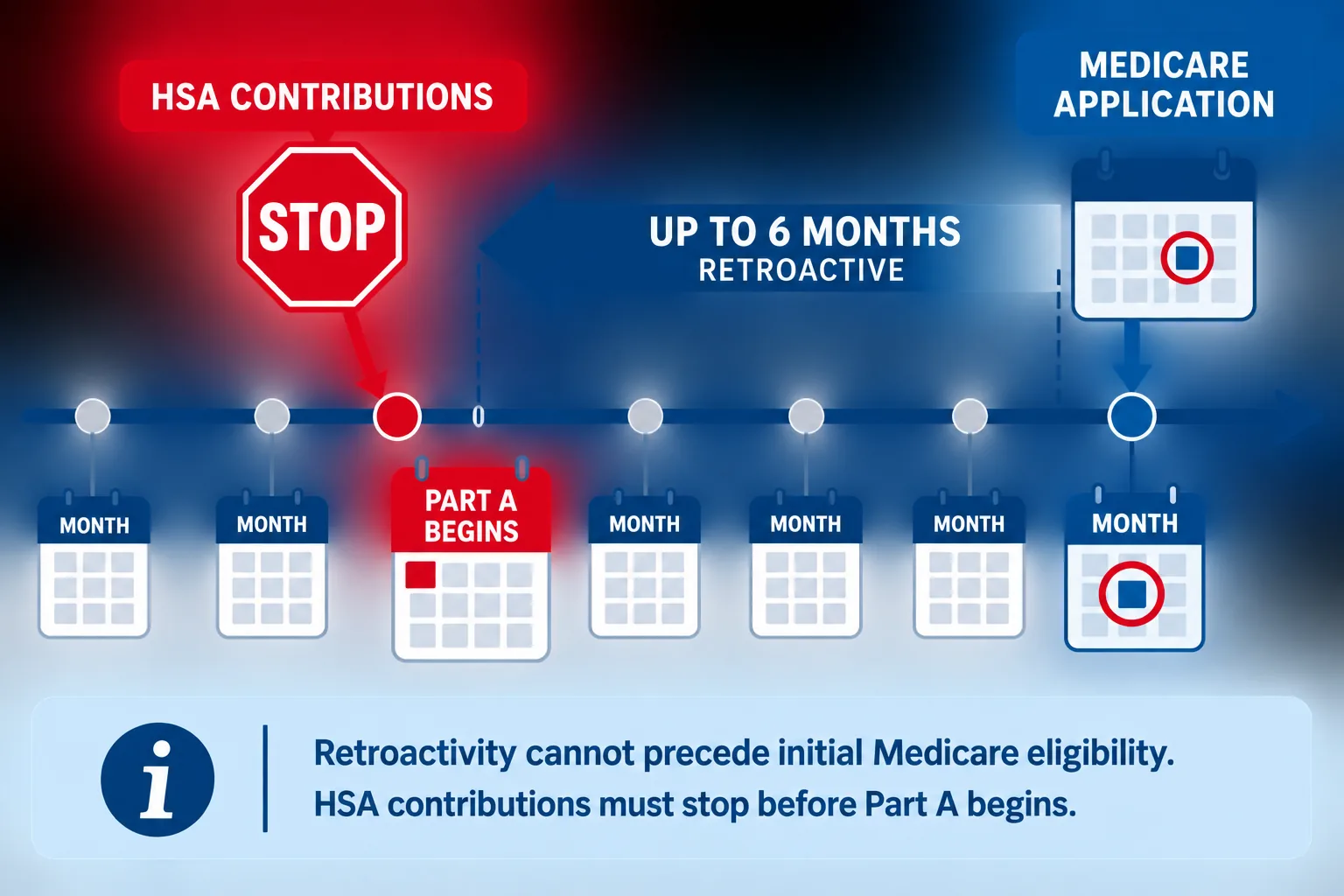
The dangerous assumption is that HSA eligibility ends on the day you submit a Medicare application. For some people who enroll after 65, premium-free Part A can begin retroactively by as much as six months—turning contributions already made during that period into excess contributions.
- A person enrolled in Medicare generally cannot make or receive new HSA contributions, although existing HSA money remains available.
- Medicare advises workers enrolling after 65 to stop employee and employer HSA contributions six months before applying for Medicare or Social Security.
- Part A retroactivity does not go earlier than the first month of Medicare eligibility, so the correct cutoff depends on the individual timeline.
Enrollment and eligibility are different clocks
You may be allowed to delay Medicare Part B while covered by current-employment group insurance, but that does not make HSA coordination automatic. Social Security enrollment can trigger premium-free Part A. Retiree coverage, COBRA and Marketplace coverage do not always produce the same Medicare enrollment rights as active-employer coverage. Ask the employer benefits office whether the plan is primary and whether a Special Enrollment Period will apply.
Why the six-month warning exists
When someone applies for premium-free Part A more than six months after turning 65, coverage may begin up to six months before the application month. If payroll continued HSA deposits during months later covered by Part A, those deposits may be excess. The safe rule for many late enrollees is to stop both employee and employer contributions six months before the Medicare or Social Security application—but never assume without mapping actual eligibility dates.
Turning 65 during the year requires a prorated calculation
HSA contribution limits are normally monthly. Losing HSA eligibility during a year may reduce the permitted annual amount. Employer deposits count toward the same limit as employee contributions. The age-55 HSA catch-up does not override Medicare ineligibility. A married couple also must analyze each spouse separately because Medicare enrollment and HSA ownership are individual.
What you can still do with the HSA
Medicare enrollment stops new eligible contributions; it does not confiscate the account. HSA funds can continue paying qualified medical expenses tax-free. After age 65, nonmedical withdrawals avoid the additional HSA penalty but are generally taxable as ordinary income. Medicare premiums can qualify in many situations, while Medigap premiums generally do not. Keep receipts and verify current IRS rules.

If you already contributed too much
Do not simply withdraw an arbitrary amount. Contact the HSA custodian and request its excess-contribution correction process, including attributable earnings, before the applicable tax deadline. Coordinate payroll records, Forms W-2 and 5498-SA, and the Medicare effective date. An excise tax can continue for uncorrected excess amounts, so this is a situation where a tax professional can be worth the fee.
Your six-question meeting agenda
Ask when Part A will become effective; whether Social Security filing changes that date; when the last employee and employer HSA deposits will occur; whether coverage is active-employment insurance; whether Part B can be delayed without penalty; and how the final-year HSA limit will be calculated. Get the answers in writing before changing payroll.
Bottom line
The valuable move is to verify the effective date, account type, plan document and current-year limits before moving money or filing an application. A correct rule applied to the wrong account or month can still produce an expensive result.
Important: This article provides general educational information, not individualized tax, legal, investment, Medicare or Social Security advice. Rules and individual facts can change the result.
Official resources
Reviewed August 17, 2026.