


Medicare has begun covering certain GLP-1 weight-management drugs for eligible Part D members through a temporary nationwide program. The price sounds simple—$50 for a one-month supply—but eligibility is unusually specific, prior authorization is required, and the payment sits outside the normal Part D benefit.
Which medicines and forms are covered?
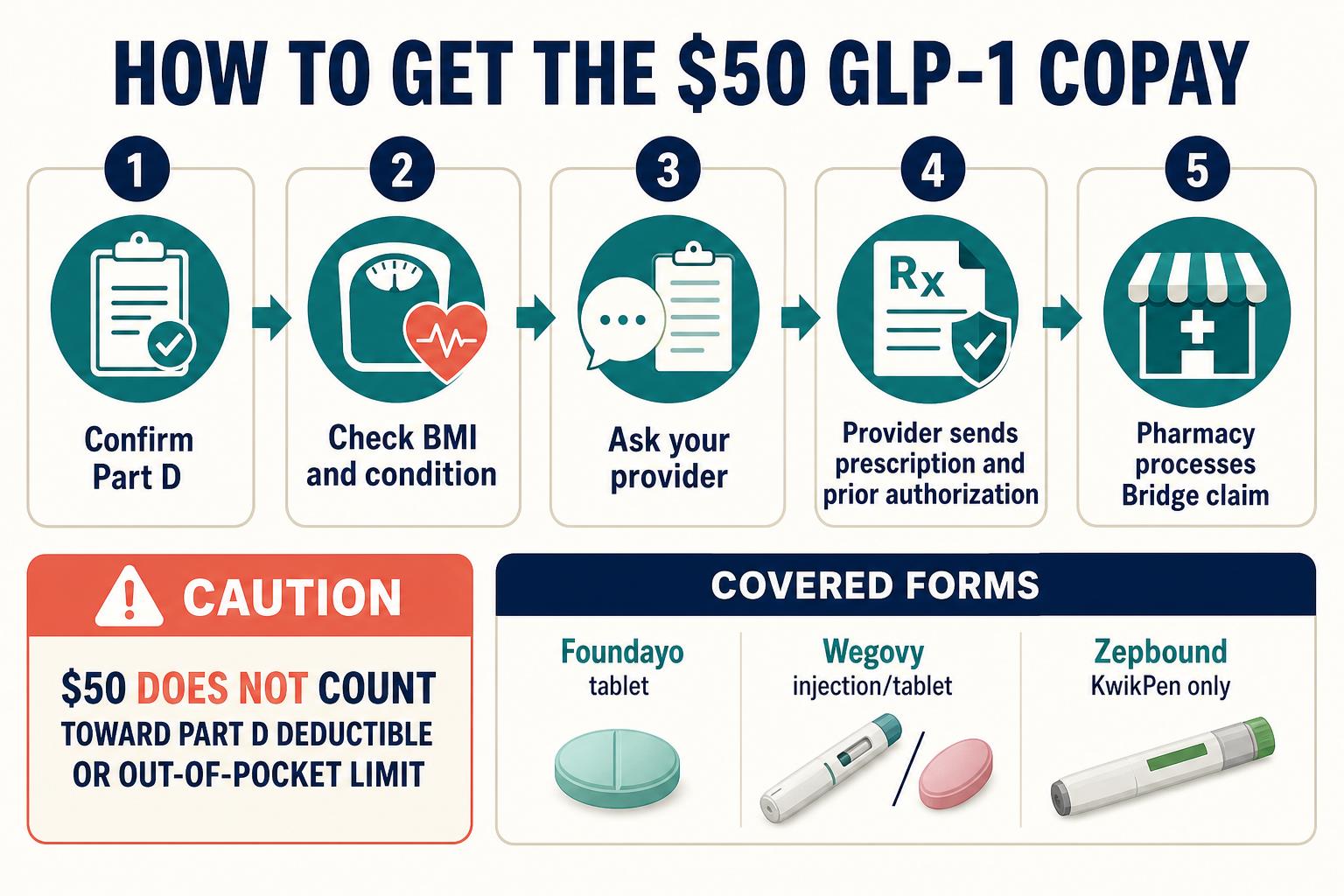
Medicare lists Foundayo tablets, Wegovy injections or tablets, and Zepbound KwikPen. Zepbound single-dose vials and pens are not covered by this program. Coverage is nationwide for qualifying members of standalone Part D plans, many Medicare Advantage plans with drug coverage, Special Needs Plans, certain employer/union plans, and LI NET.
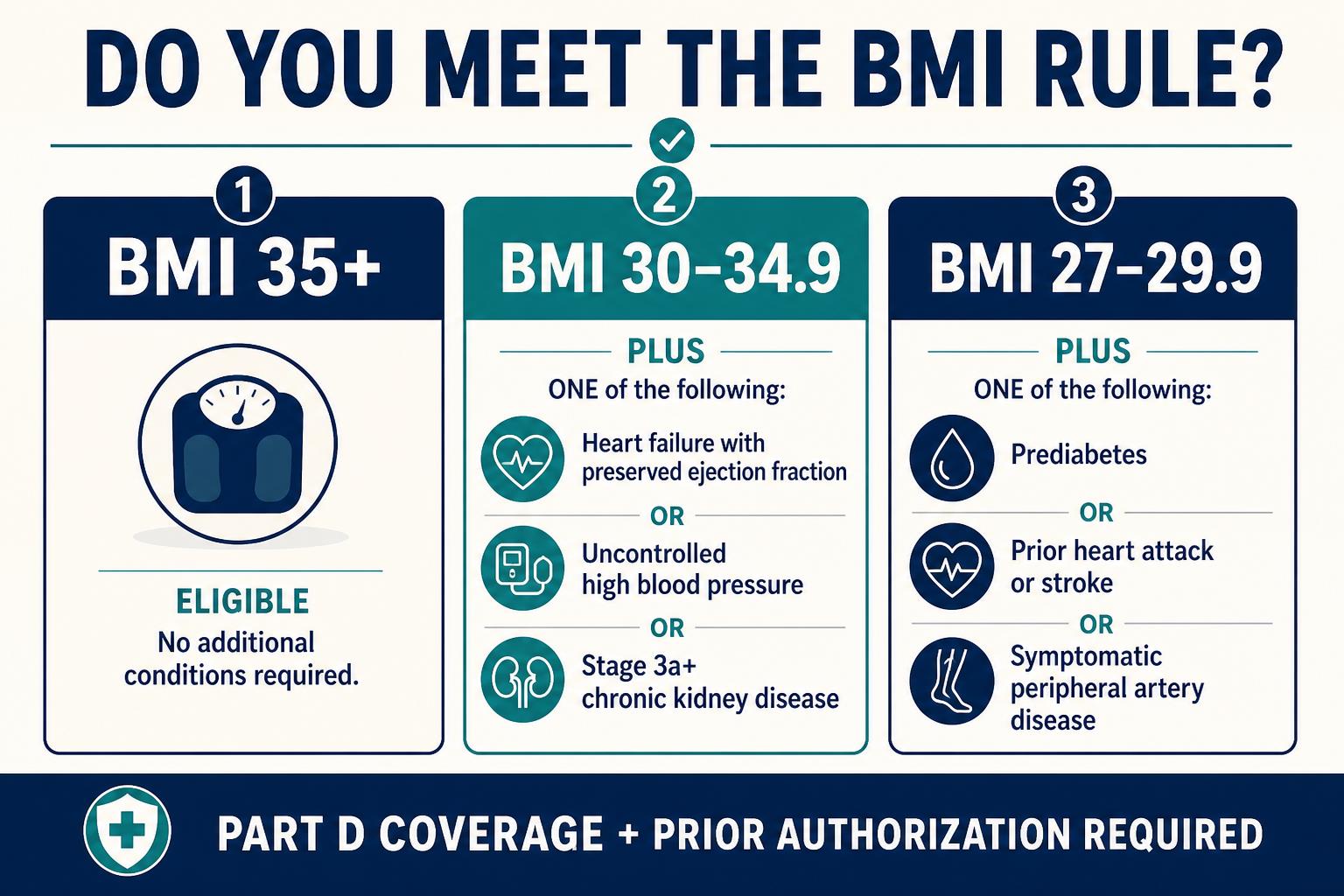
The eligibility test
| BMI when therapy starts | Additional requirement |
|---|---|
| 35 or higher | No additional listed condition is required under the Bridge BMI pathway. |
| 30–34.9 | At least one: heart failure with preserved ejection fraction, uncontrolled hypertension, or chronic kidney disease stage 3a or higher. |
| 27–29.9 | At least one: prediabetes, prior heart attack or stroke, or symptomatic peripheral artery disease. |
Who is excluded from the Bridge?
You are not eligible through this particular program if your Part D plan already covers your GLP-1 medicine. CMS also says people with type 2 diabetes, moderate-to-severe sleep apnea, or fatty liver disease are not eligible for the Bridge because their regular Part D plan may cover a GLP-1 for those conditions. That does not mean “no coverage”; it means the claim should follow the regular plan pathway.
How to start without getting bounced between offices
- Confirm active Part D coverage. Call the number on your plan card or 1-800-MEDICARE.
- Document BMI and diagnosis. Ask the provider which exact Bridge criterion appears in your medical record.
- Discuss medical suitability. Eligibility does not establish that the medication is safe or appropriate for you.
- Send the correct prescription. Product form matters, especially for Zepbound.
- Complete prior authorization. The provider must certify participation in a lifestyle program focused on diet and exercise.
- Check status before paying cash. Medicare says you can call 1-800-MEDICARE to check the prior-authorization status.
The $50 detail many people will miss
The $50 copay covers a 28- or 30-day supply. Because the Bridge operates outside normal Part D coverage:
- It does not count toward the Part D deductible.
- It does not count toward the yearly Part D out-of-pocket limit.
- It will not appear on the Part D Explanation of Benefits or Medicare Summary Notice.
- Extra Help cannot lower the $50 amount.
- The Medicare Prescription Payment Plan cannot spread it across months.
Over 12 fills, the copays alone would total $600. Visits, lab work or other services ordered by the provider may create separate costs, so ask what Medicare covers before testing or follow-up care.
Questions to bring to the appointment
- Which eligibility pathway do I meet, and is it documented?
- Which covered medicine and dosage form are you prescribing?
- What side effects and medication interactions matter for me?
- What monitoring, nutrition and exercise plan is required?
- Who in the office handles the prior authorization?
- If authorization is denied, who will request the reason and correct the record?
If the claim is rejected
First determine whether the problem is eligibility, prior authorization, the prescribed form, member identification or pharmacy processing. Ask for the exact rejection message—not simply “Medicare does not cover it.” Call 1-800-MEDICARE with your Medicare number, prescription details and pharmacy information. If your plan already covers the drug for another condition, contact the plan rather than attempting to force the Bridge route.
FAQ
Does every person with obesity qualify?
No. Part D coverage and the defined BMI/condition criteria apply, and the provider must complete the clinical process.
Does the $50 count toward the 2026 $2,100 Part D out-of-pocket cap?
No. CMS states that Bridge copays do not count toward Part D true out-of-pocket spending.
Will approval last?
CMS says an approved prior authorization, including refills and dose changes, is valid through December 31, 2027 unless the member changes GLP-1 medicines.
Where is the official screening tool?
Use Medicare’s GLP-1 Bridge eligibility page and the CMS program FAQ.
This article is educational and does not replace medical advice or confirm individual eligibility. A licensed clinician and Medicare make the applicable decisions.