


The AI buildout is no longer merely a technology story. It is becoming one of the largest capital-allocation and credit-market experiments of the decade. The question shareholders should ask is not whether AI demand is real. It is whether the cash earned from that demand will arrive before depreciation, financing costs and competitive price cuts consume the return.
- Goldman Sachs estimated that hyperscaler capital spending could approach $750 billion in 2026, according to a July Reuters analysis.
- The BIS has documented growing use of bonds, private credit and off-balance-sheet structures to finance AI infrastructure.
- The Federal Reserve’s May 2026 stability review described equity valuations as elevated, making execution disappointments more consequential.
The wrong question is “Will AI grow?”
AI use can grow rapidly while an AI investment still produces a disappointing shareholder return. Revenue is only the first line of the calculation. Investors must subtract electricity, networking, cooling, maintenance, employee compensation and the depreciation of accelerators and servers that can become economically outdated well before a building does. A company can report booming cloud demand while the return on each new dollar of infrastructure quietly falls.
Follow the money beyond the familiar balance sheet
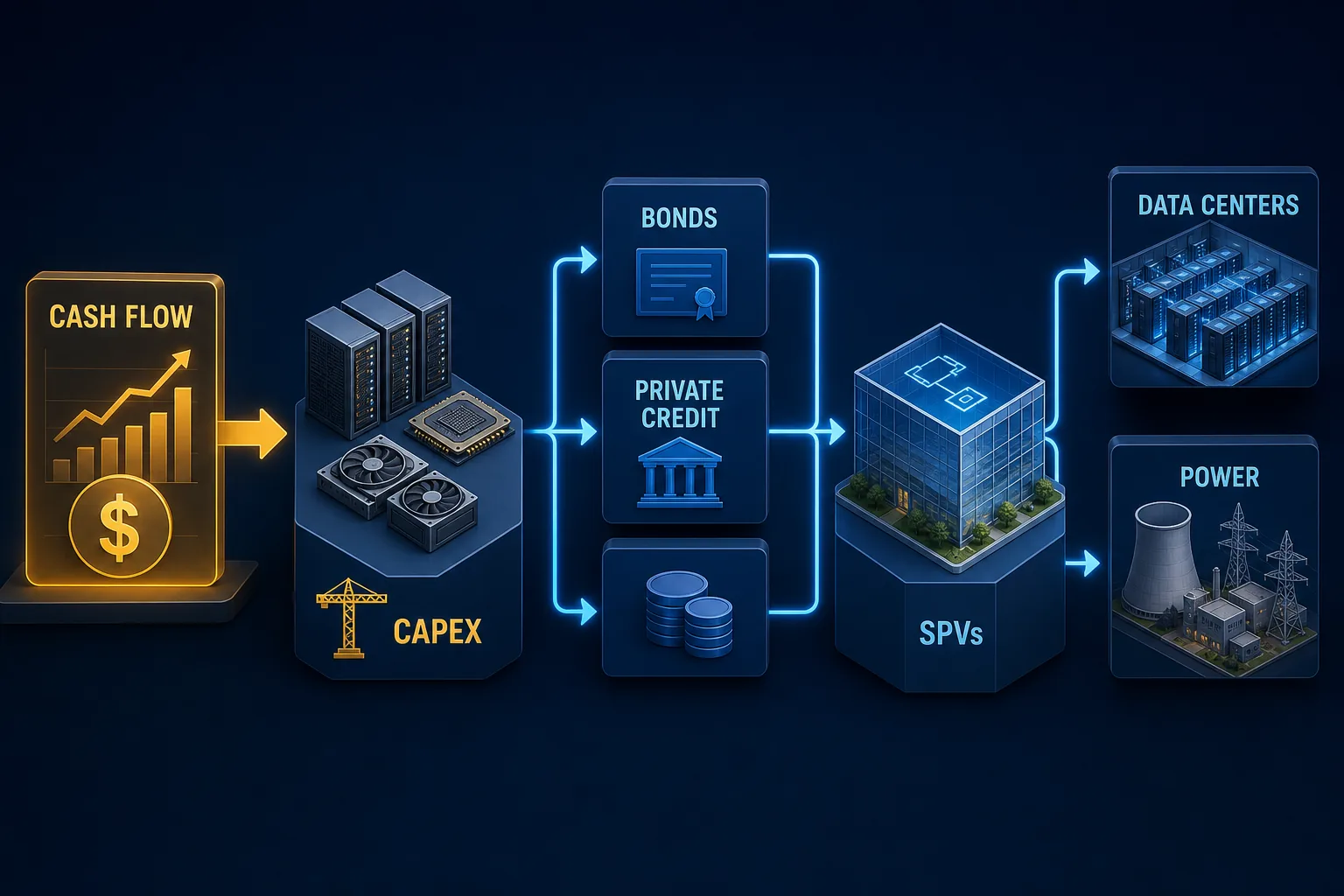
The first wave of hyperscaler spending was largely supported by enormous operating cash flow. The next wave increasingly involves corporate bonds, project debt, private credit, joint ventures and special-purpose vehicles. These structures are not automatically reckless; matching a long-lived facility with long-term capital can be sensible. But they make risk harder to see. A lease commitment, purchase agreement, capacity guarantee or equity backstop may behave like debt even when it does not sit beside conventional bonds in the headline debt total.
A five-part return test for shareholders
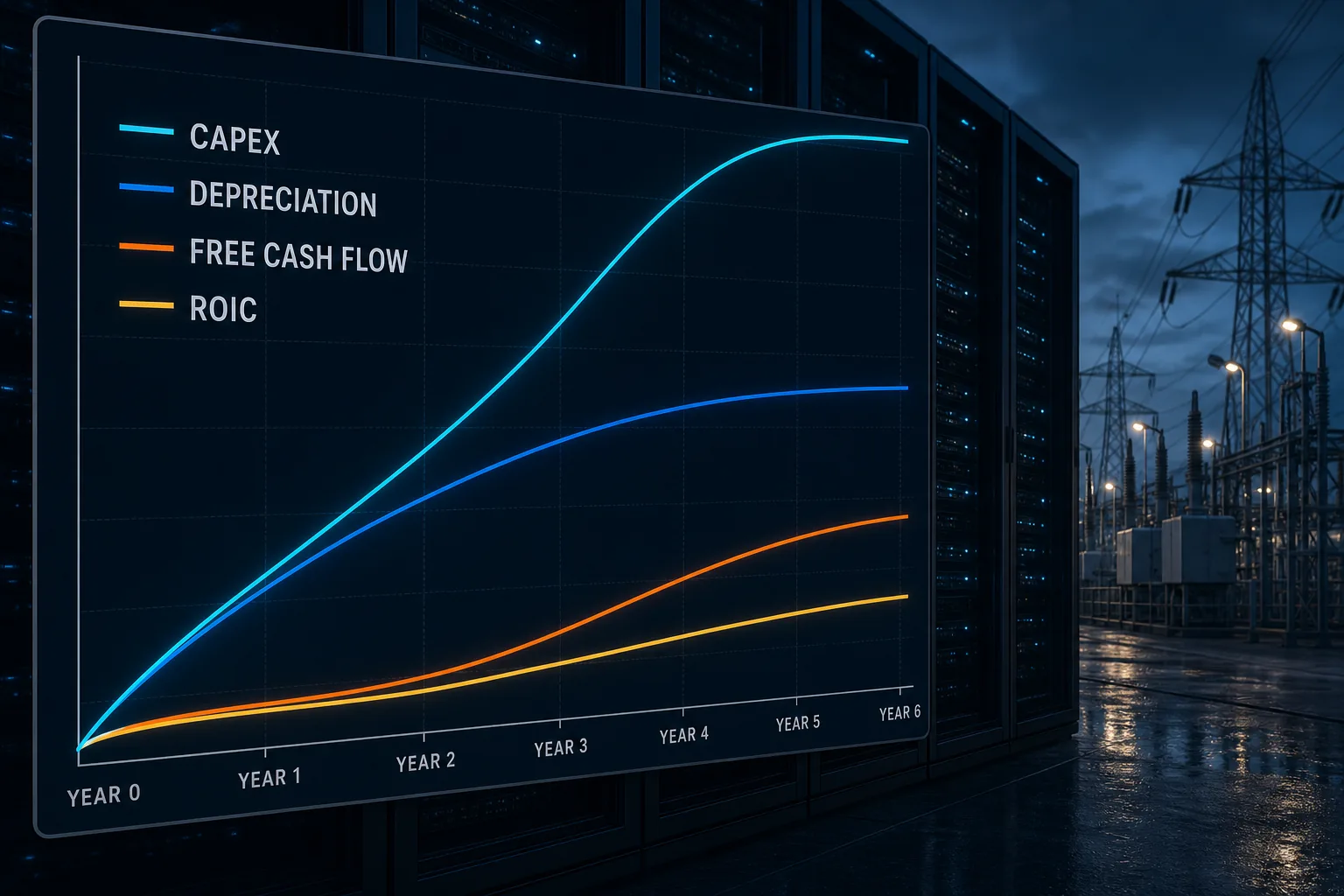
First, track incremental revenue against incremental capex. If spending rises much faster than revenue for several years, management should explain the path to utilization. Second, watch free cash flow after capex, not operating cash flow alone. Third, compare return on invested capital with the company’s cost of capital. Fourth, examine depreciation growth, because today’s capital bill becomes tomorrow’s recurring expense. Fifth, separate external customer demand from circular demand in which AI developers funded by the ecosystem use that capital to buy cloud and chips from the same ecosystem.
The hidden second-order effect: everyone else pays more
A heavy stream of high-grade technology bonds competes with industrial companies, utilities and other borrowers for investor capital. That does not mean every new AI bond pushes all yields sharply higher, but supply matters at the margin. Utilities also need vast investment for generation and transmission. When financing costs rise across the chain, part of the AI bill can migrate into electricity rates, cloud prices, reduced corporate investment elsewhere and lower future buybacks.
Who is most exposed if returns arrive late?
The weakest link may not be the company with the best balance sheet. Look at data-center developers dependent on one tenant, utilities building ahead of firm demand, private-credit vehicles with optimistic residual values, and chip or networking suppliers priced for uninterrupted growth. Also examine contract duration. A 15-year financing plan is vulnerable if computing hardware is replaced in four years or if customers can renegotiate capacity prices much sooner.
What would prove the bulls right?
A durable bullish case needs evidence: utilization that stays high as capacity expands; AI revenue disclosed with enough detail to compare against investment; stable or improving cloud margins; depreciation and power costs growing more slowly than revenue; and customer productivity gains large enough to support renewal without subsidies. The most important signal is not a flashy model release. It is broad, recurring cash payment from customers outside the small circle of heavily funded AI companies.
My view: the boom can be real and overpriced at the same time
I do not view AI infrastructure as an empty bubble. The demand for computing, inference and automation is genuine. But a genuine technological shift does not guarantee that every layer earns excess returns. Railroads transformed commerce while many railroad securities disappointed. Fiber-optic capacity changed the internet while owners suffered from oversupply. The likely outcome is uneven: tremendous economic value, strong profits for a few bottlenecks, commodity-like returns for some capacity owners, and painful write-downs where financing assumed perfection.
The investor checklist for the next earnings call
- How much AI-related capex is committed, and how much can be delayed?
- What portion is financed with debt, leases, guarantees or joint ventures?
- How fast will depreciation expense grow over the next eight quarters?
- What is the utilization rate of newly opened capacity?
- What portion of AI revenue comes from a small number of venture-funded customers?
- Is free cash flow per share rising after stock compensation and capex?
Frequently asked questions
Does more debt mean the AI boom will collapse?
No. Debt can efficiently finance long-lived assets. The warning appears when cash flows are uncertain, maturities are short, covenants are tight or investors cannot see the full obligation.
What single metric matters most?
No single metric is sufficient, but free cash flow after capex combined with incremental return on invested capital is far more revealing than revenue growth alone.
Should ordinary investors sell technology index funds?
This article cannot answer an individual allocation question. A practical first step is to calculate how much technology and AI exposure already exists across all funds before adding a concentrated stock position.
Important: This article is for general educational information and does not provide individualized investment, tax, legal or financial advice. Rates, market conditions and company disclosures can change after publication.
Verify the current data
- BIS: Financing the AI infrastructure boom
- Federal Reserve Financial Stability Report
- SEC EDGAR company filings
Reviewed and updated August 15, 2026.