


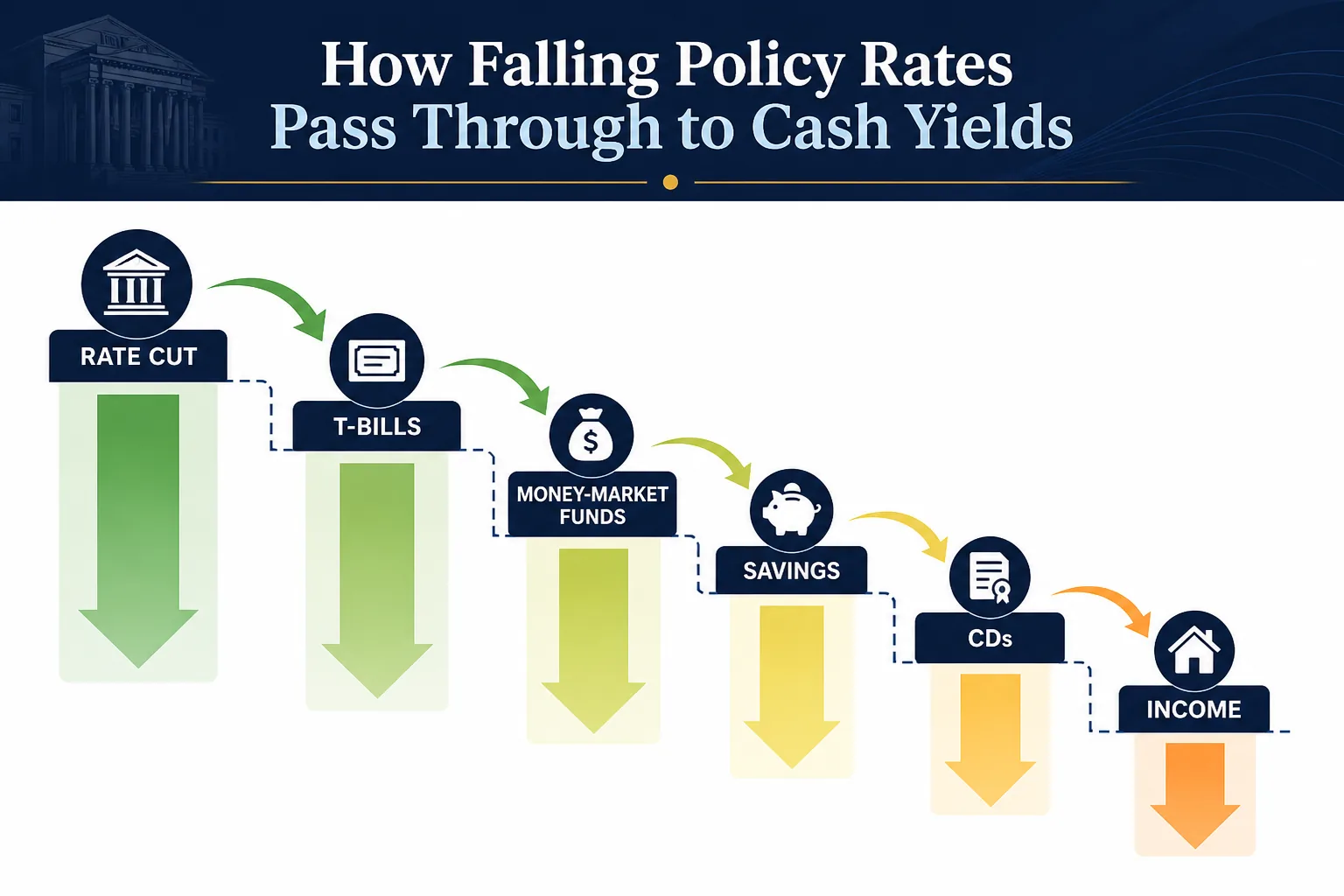
Cash has felt unusually comfortable: liquid, comparatively stable and capable of producing meaningful income. That comfort creates a hidden risk. When short-term rates fall, the saver does not lose principal in the usual sense—the income simply disappears at the next reset, often before the saver has decided where the money should go.
- ICI reported roughly $7.89 trillion in U.S. money-market fund assets for the week ended July 15, 2026.
- On July 29, 2026, the Federal Reserve maintained a 3.50%–3.75% target range, while emphasizing uncertainty around inflation and policy.
- SEC data for May 2026 showed money-market yields varied by category; a fund’s quoted yield is neither permanent nor a bank deposit guarantee.
Reinvestment risk is an income problem, not a headline loss
A Treasury bill matures at face value and a money-market fund seeks stability, so the danger can feel invisible. Yet a household relying on interest income can experience a meaningful budget shock. A $250,000 cash balance earning 4% produces about $10,000 a year before tax. At 2%, it produces about $5,000. The account balance may look unchanged while annual spending power falls by $5,000.
Why cash yields can fall quickly
Money-market portfolios own short-dated instruments that mature and are replaced frequently. That is why their yields rose relatively quickly when the Federal Reserve tightened—and why they can fall quickly when market rates decline. High-yield savings rates are administered by banks and can change at any time. A certificate of deposit locks a rate only until maturity. The advertised annual percentage yield is therefore a snapshot, not a lifetime income promise.
Do not confuse three different jobs for cash
Emergency liquidity must be accessible and should not be stretched for a little extra yield. Known near-term spending—taxes, tuition, a home purchase or living expenses—needs maturity dates aligned with the bill. Long-term investment capital has a different job: preserving purchasing power and funding goals years away. The reinvestment trap begins when long-term capital remains in cash merely because the current yield feels good.
The decision should begin with a spending calendar
List the dollars needed within 30 days, one year, three years and five years. Keep the immediate bucket liquid. Match known bills with Treasury bills or insured CDs that mature before the payment date. Money not needed for several years can then be evaluated against intermediate bonds or a diversified portfolio appropriate to the owner’s risk tolerance. This prevents a rate forecast from controlling the entire plan.
How a ladder reduces the all-at-once problem
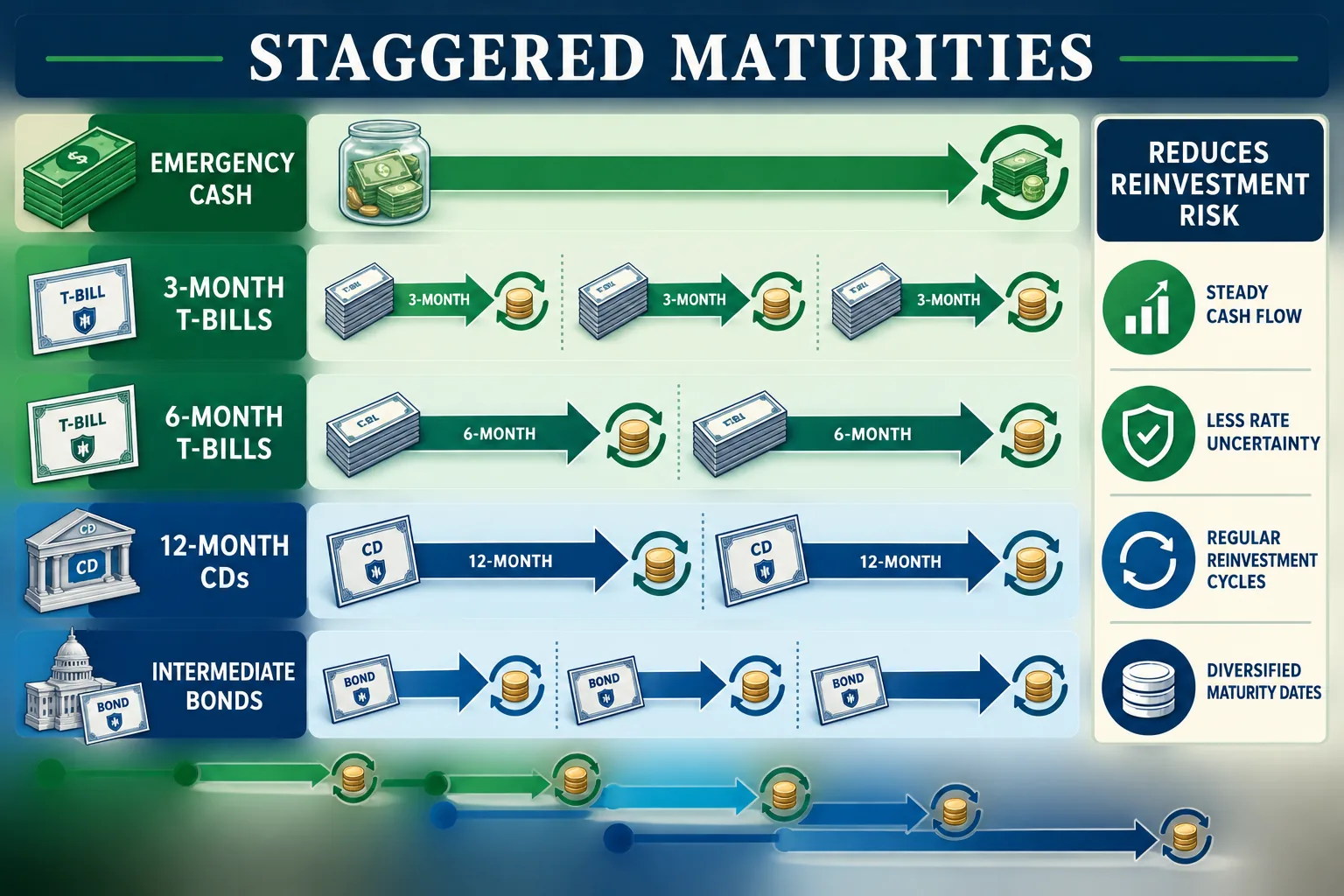
A ladder divides money across several maturities. Some funds remain liquid; other portions mature at three, six and twelve months; a longer portion can extend duration when appropriate. If rates rise, maturing short rungs can reinvest higher. If rates fall, longer rungs preserve part of the earlier yield. The tradeoff is deliberate: a ladder sacrifices the chance of making one perfect rate call in exchange for reducing the damage from one badly timed call.
Tax and insurance details can reverse the comparison
Treasury interest is generally exempt from state and local income tax, while bank and money-market interest is usually taxable at those levels. Municipal money-market funds may appeal to some higher-tax-bracket investors but are not automatically superior. Bank CDs and deposits may carry FDIC insurance within applicable limits; money-market mutual funds are securities and are not FDIC-insured. Brokerage cash-sweep arrangements also vary. Compare after-tax yield, protection, liquidity and fees—not just the largest number on a screen.
My view: do not turn a cash decision into a rate bet
Nobody knows the exact path of policy rates. In July the Federal Reserve held rates and several voters preferred a hike, reminding savers that the next move is not guaranteed. The right response is not to rush every dollar into long bonds. It is to decide which dollars must stay safe and liquid, which have a known date, and which are actually long-term capital. Duration should follow the liability, not a television prediction.
A 20-minute cash audit
- Record every cash account, current seven-day yield or APY, and next reset or maturity date.
- Separate emergency cash from money reserved for a known bill.
- Check FDIC coverage and whether a brokerage position is a bank sweep or a money-market mutual fund.
- Calculate annual interest income if yields fall by one and two percentage points.
- Compare Treasury, CD and fund yields after federal and state taxes.
- Stagger maturities instead of moving the entire balance on one forecast.
Frequently asked questions
Will my money-market fund lose money when rates fall?
Usually the immediate effect is a lower yield rather than a principal loss, but money-market mutual funds are investments and are not risk-free or FDIC-insured.
Should I lock everything into a CD now?
Locking everything can create liquidity and opportunity-cost problems. Match maturities to actual spending needs and observe deposit-insurance limits.
Are longer-term bonds safer than cash?
They carry price risk when yields change. They may stabilize future income, but they are not a substitute for emergency liquidity.
Important: This article is for general educational information and does not provide individualized investment, tax, legal or financial advice. Rates, market conditions and company disclosures can change after publication.
Verify the current data
- Federal Reserve July 2026 FOMC statement
- ICI weekly money-market fund assets
- SEC money-market fund yield statistics
- TreasuryDirect
Reviewed and updated August 15, 2026.