


A property-tax assessment is not automatically the amount your home would sell for, and a large increase is not by itself proof that the assessor is wrong. A successful appeal usually turns on a narrower question: what was the property’s legally relevant value on the valuation date, based on evidence your local review body is allowed to consider?
- Find the filing deadline before researching value; missing it can end the case.
- Audit the official property record for factual errors before debating market trends.
- Use genuinely comparable closed sales near the valuation date and state one supported requested value.
Start with the deadline and the local rules
Property-tax appeals are local proceedings. The assessment notice or county website should identify the valuation date, filing window, required form, filing fee, hearing process and whether an informal review is available before a formal appeal.
Do not assume that paying the bill, calling the assessor or sending an email preserves appeal rights. Ask the clerk or assessor in writing which action constitutes a timely filing, and retain the confirmation number, timestamp and complete submission.
Some jurisdictions let a board raise as well as lower an assessment. Read the risk disclosure and determine whether the likely tax saving justifies the time, appraisal cost or representation fee.
Audit the assessor’s property record
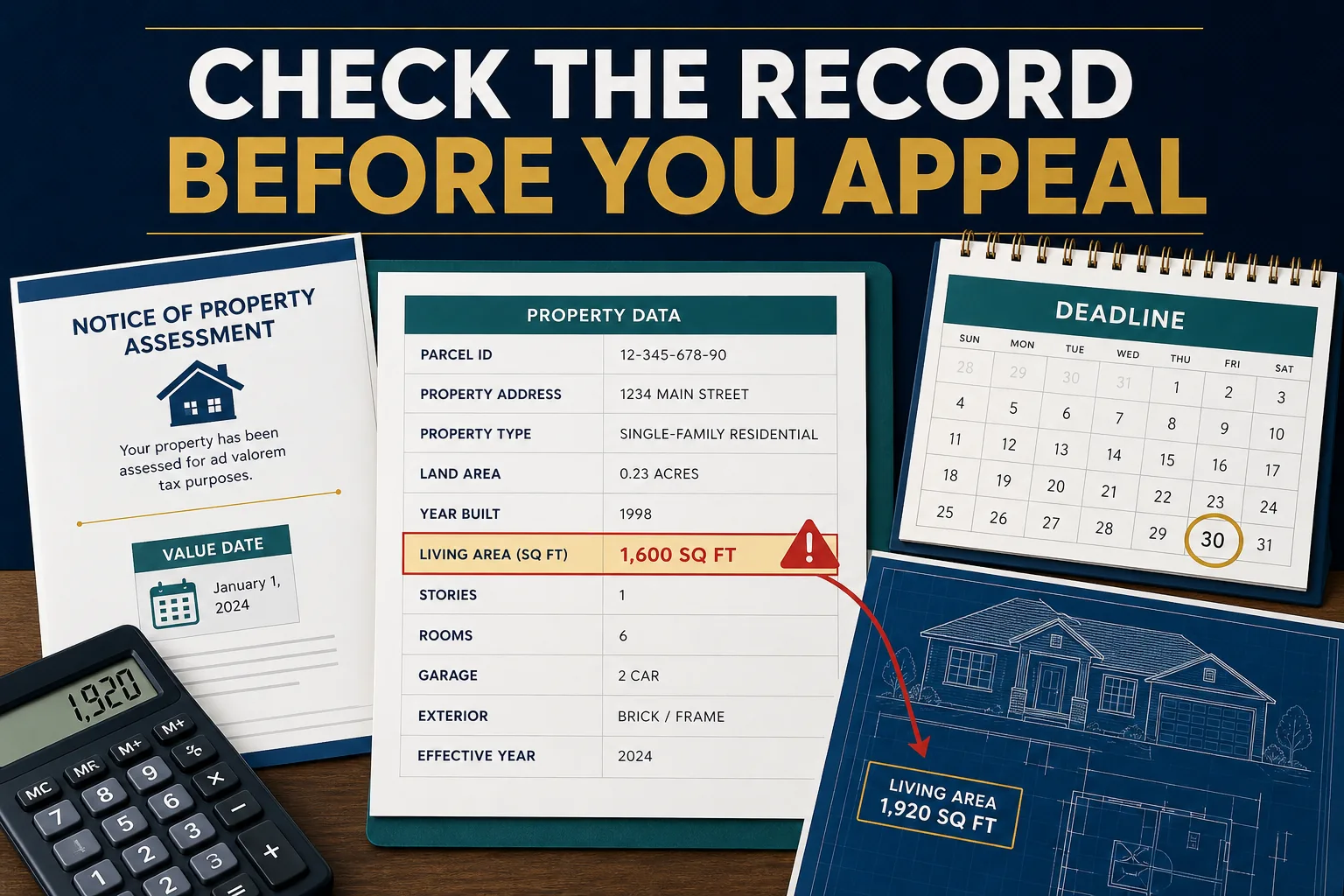
Download the property card and compare every material characteristic with the house: living area, lot size, bedrooms, bathrooms, basement finish, garage, construction quality, condition, renovations and permitted additions. Mass-appraisal systems can produce a defensible neighborhood estimate while still carrying a wrong fact about one home.
Document an error with objective proof such as a survey, floor plan, permit record, dated photographs or contractor report. Distinguish living area from unfinished basements, garages and enclosed porches according to the assessor’s definitions rather than your listing agent’s terminology.
Calculate the real tax impact first
A lower assessed value does not always reduce the bill dollar for dollar because exemptions, assessment ratios, levy rates and caps vary. Estimate the result using the local formula before spending hundreds of dollars on an appraisal.
For example, if a jurisdiction taxes 80% of value at an effective rate of 1.5%, reducing value by $40,000 might reduce annual tax by roughly $480: $40,000 × 80% × 1.5%. This illustration is not a universal formula; use your jurisdiction’s actual ratio and levies.
Choose comparable sales the board can trust
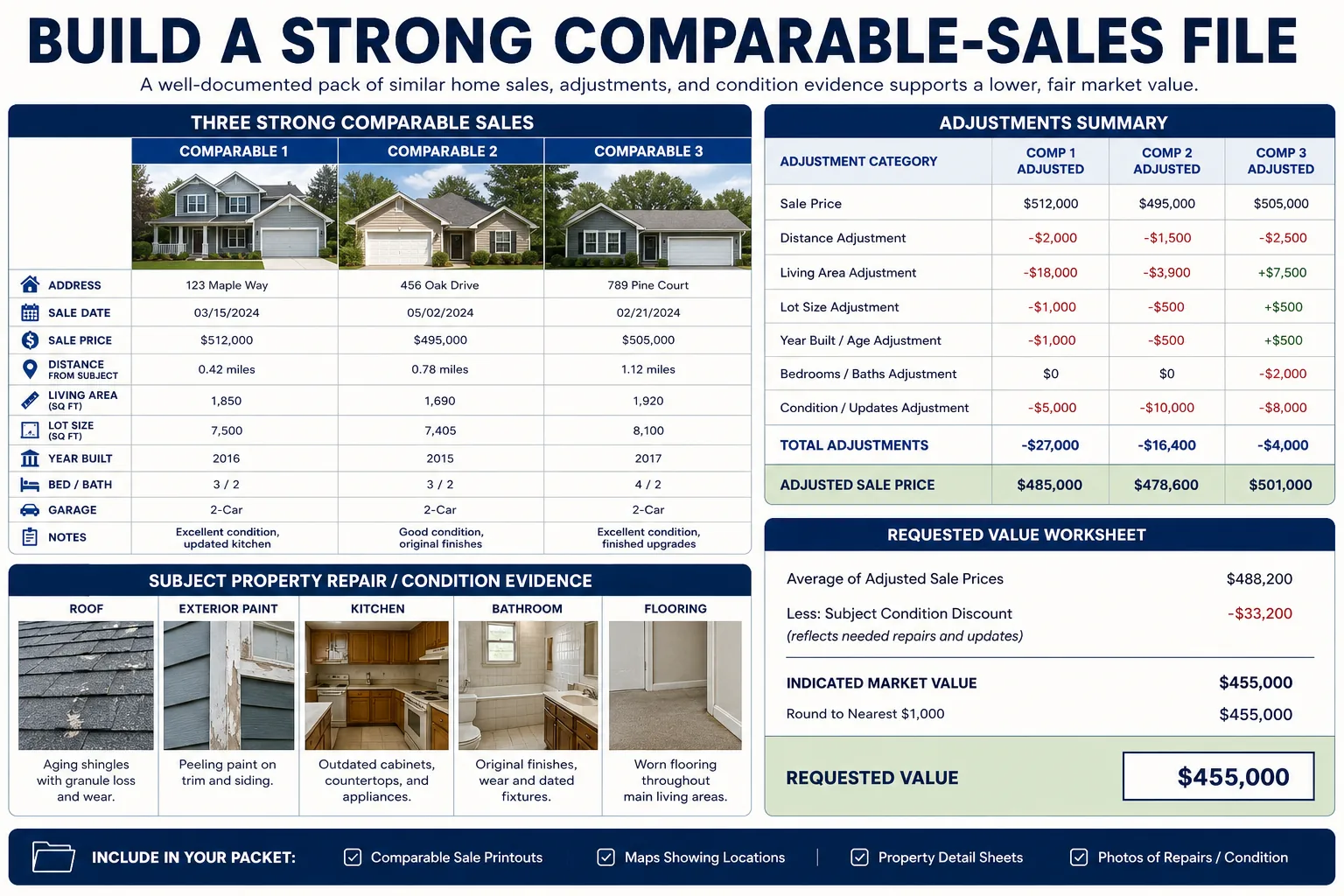
Closed sales are usually stronger than active listings because a listing is an asking price, not a completed transaction. Favor properties close to the subject, sold near the valuation date, with similar location, property type, size, age, condition, lot and amenities.
Do not cherry-pick the three cheapest houses while ignoring obvious differences. Explain each adjustment: a comp with a remodeled kitchen, larger garage or superior school boundary may need a downward adjustment before it supports your requested value.
California guidance, for example, says residential comparable sales are highly useful and limits consideration of sales occurring more than 90 days after the valuation date. Other states use different windows, illustrating why local instructions control.
Build a one-number evidence packet
Lead with a one-page summary: assessed value, requested value, valuation date, primary error and three to five best pieces of evidence. Follow with the property record, comparable-sale sheets, map, photographs and a transparent adjustment worksheet.
Ask for a specific supported value instead of saying the bill is unfair. A tax increase caused by a higher levy, expiring exemption or neighborhood-wide change may not prove that the property valuation itself is excessive.
Prepare for the informal review or hearing
Practice a three-minute explanation that begins with the requested value and valuation date. Walk through the strongest property-record error or comparable sale, acknowledge differences honestly, and keep every document in the order it appears in your summary.
Ask whether evidence submitted with the application must be presented again at the hearing. California’s guidance warns that an appeals board considers evidence actually presented at the hearing, not merely material previously attached or discussed; local rules elsewhere may differ.
A worked example of a focused appeal
Assume a notice values a 1,700-square-foot house at $510,000, but the county record incorrectly lists 1,920 square feet. Three nearby 1,650-to-1,750-square-foot homes sold near the valuation date for adjusted prices of $452,000, $463,000 and $469,000.
The homeowner should not merely average online estimates. A stronger packet documents the square-footage error, explains why the three sales match the legal valuation date and neighborhood, adjusts for a garage or renovation difference, and requests perhaps $461,000 based on the resulting range.
The board could reject an unsupported adjustment or select another value, but this presentation gives it verifiable facts and a reasoned number. It also keeps the argument about market value rather than the owner’s income, tax burden or dislike of the increase.
Avoid these mistakes—and use this checklist
Common mistakes include missing the filing window, using today’s market instead of the statutory valuation date, comparing unlike properties, arguing only that taxes rose, and failing to quantify a requested value. Also verify homestead, senior, veteran, disability or income-based relief separately because an exemption application may save more than a valuation appeal.
Checklist: save the notice; calendar every deadline; confirm the valuation date; audit the property card; calculate likely savings; collect closed sales; document condition differences; request one value; file through the official channel; retain proof; prepare duplicate hearing packets; and track the written decision and next appeal deadline.
Important: This guide provides general educational information. Property, travel, retirement, insurance and tenant rules can vary by location, plan, policy and individual facts; verify current official instructions before acting.
- California Board of Equalization assessment-appeal FAQs
- Illinois Department of Revenue property-tax appeals
- King County guide to appealing an assessment
Reviewed August 18, 2026.