

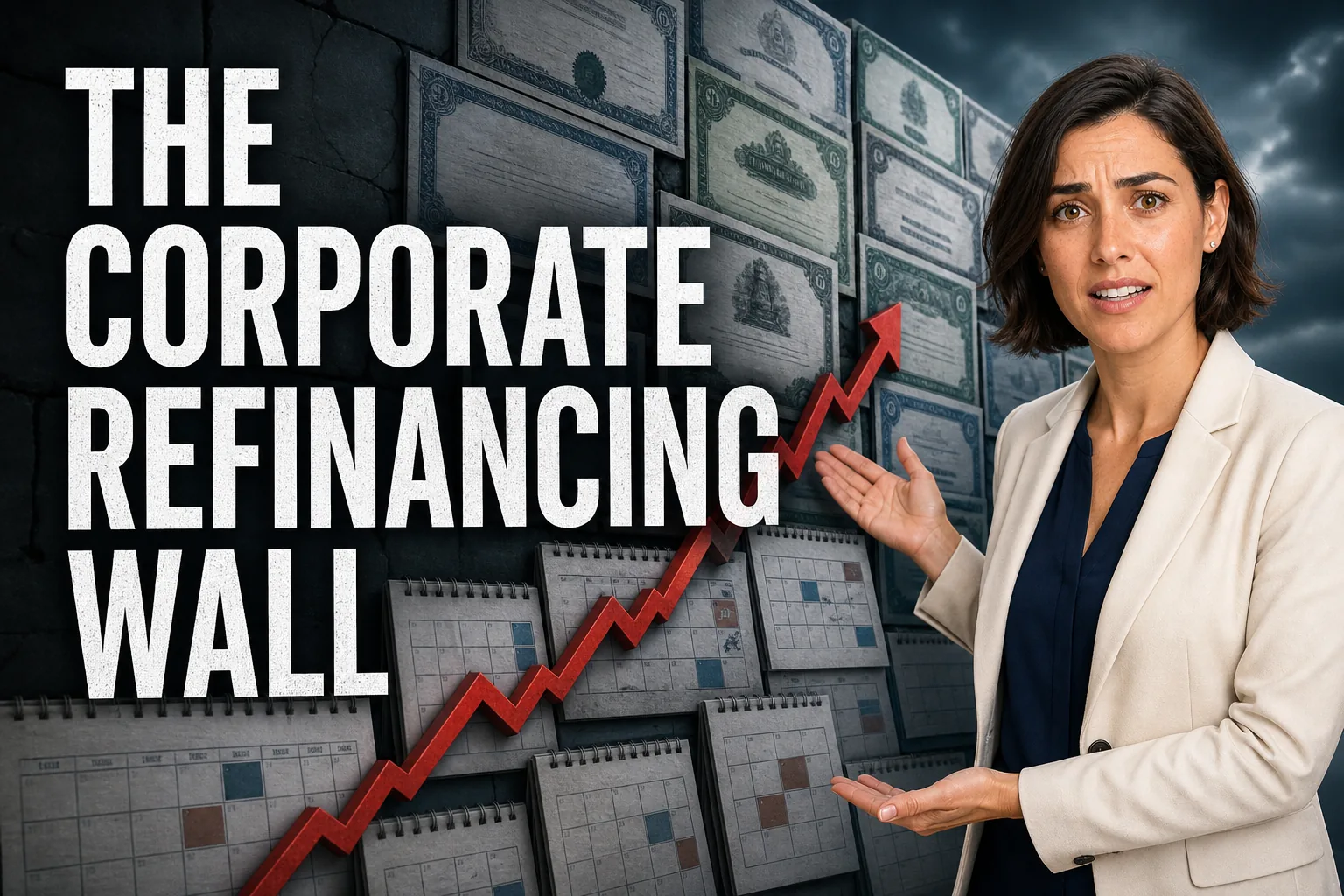
The most dangerous phrase in a credit cycle may be “nothing has broken yet.” Many companies locked in cheap, fixed-rate debt for years. That delayed the pain of higher rates—but did not erase it. As maturities approach, the old coupon is replaced by the current market price of money, and the effect can move from an obscure bond table into earnings, buybacks, hiring and eventually stock valuations.
- The Federal Reserve’s May 2026 review assessed overall business-debt vulnerabilities as moderate, not an immediate system-wide crisis.
- The same review found weaker debt-servicing capacity among some non-investment-grade and riskier private firms, especially those using floating-rate leveraged loans and private credit.
- Low corporate bond spreads can indicate confidence, but also leave investors with less compensation if defaults or downgrades rise.
Why the rate shock arrives late
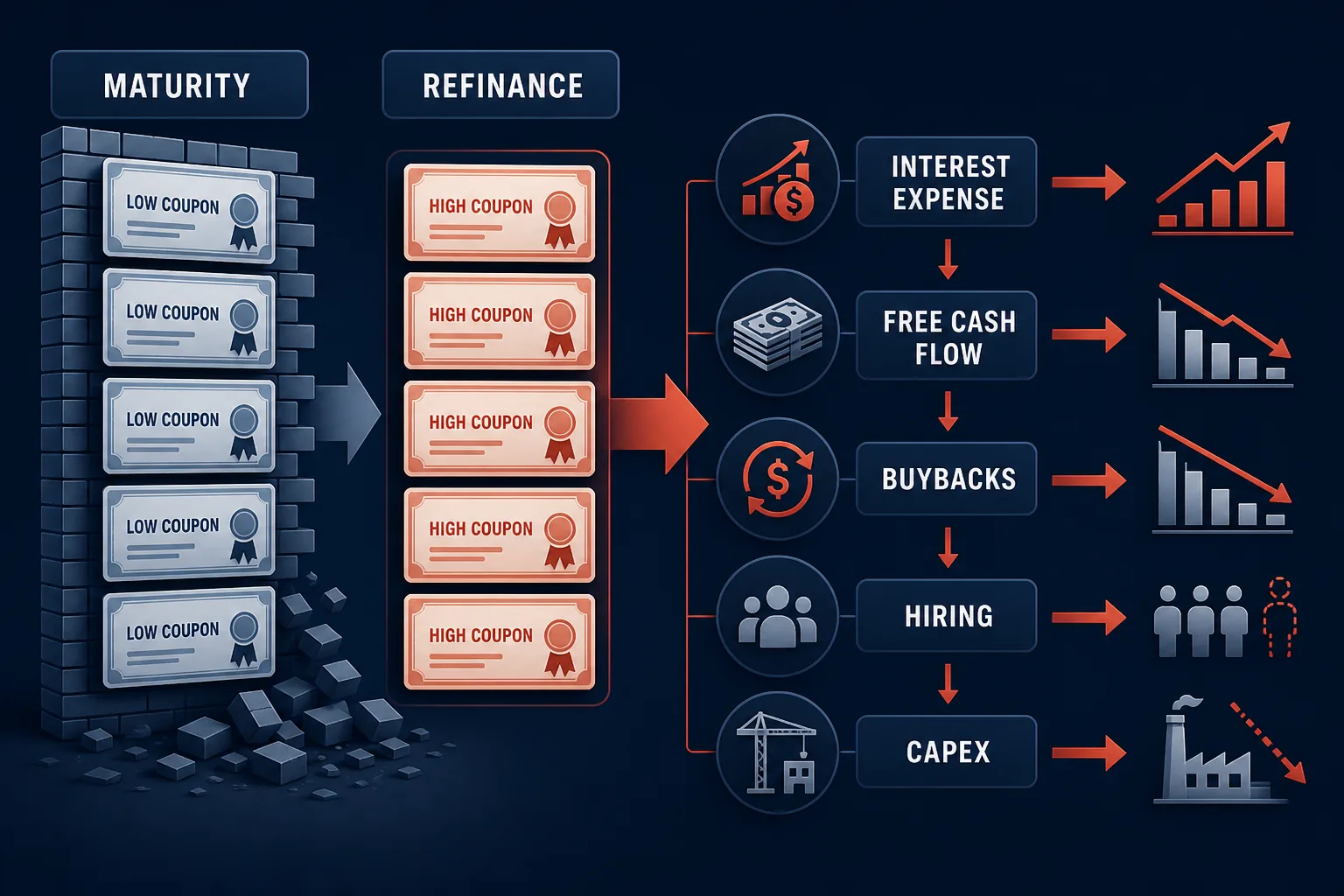
A company that issued a ten-year fixed-rate bond at a low coupon does not pay today’s rate until the bond matures or is refinanced. That creates a lag between monetary tightening and corporate pain. Floating-rate borrowers feel it sooner. Fixed-rate issuers face a calendar. The refinancing wall is therefore not one national expiration date; it is a sequence of company-specific cliffs hidden in debt footnotes.
The simple math shareholders should perform
Suppose a company must replace $2 billion of 3% debt with 7% debt. Annual interest expense rises by roughly $80 million before tax. If operating profit is $400 million, that is not a footnote—it absorbs one-fifth of the prior operating profit. A highly profitable company can handle it. A cyclical business, a sponsor-owned company or a firm already burning cash may respond by cutting investment, issuing shares, selling assets or renegotiating with lenders.
Debt size alone is a poor risk measure
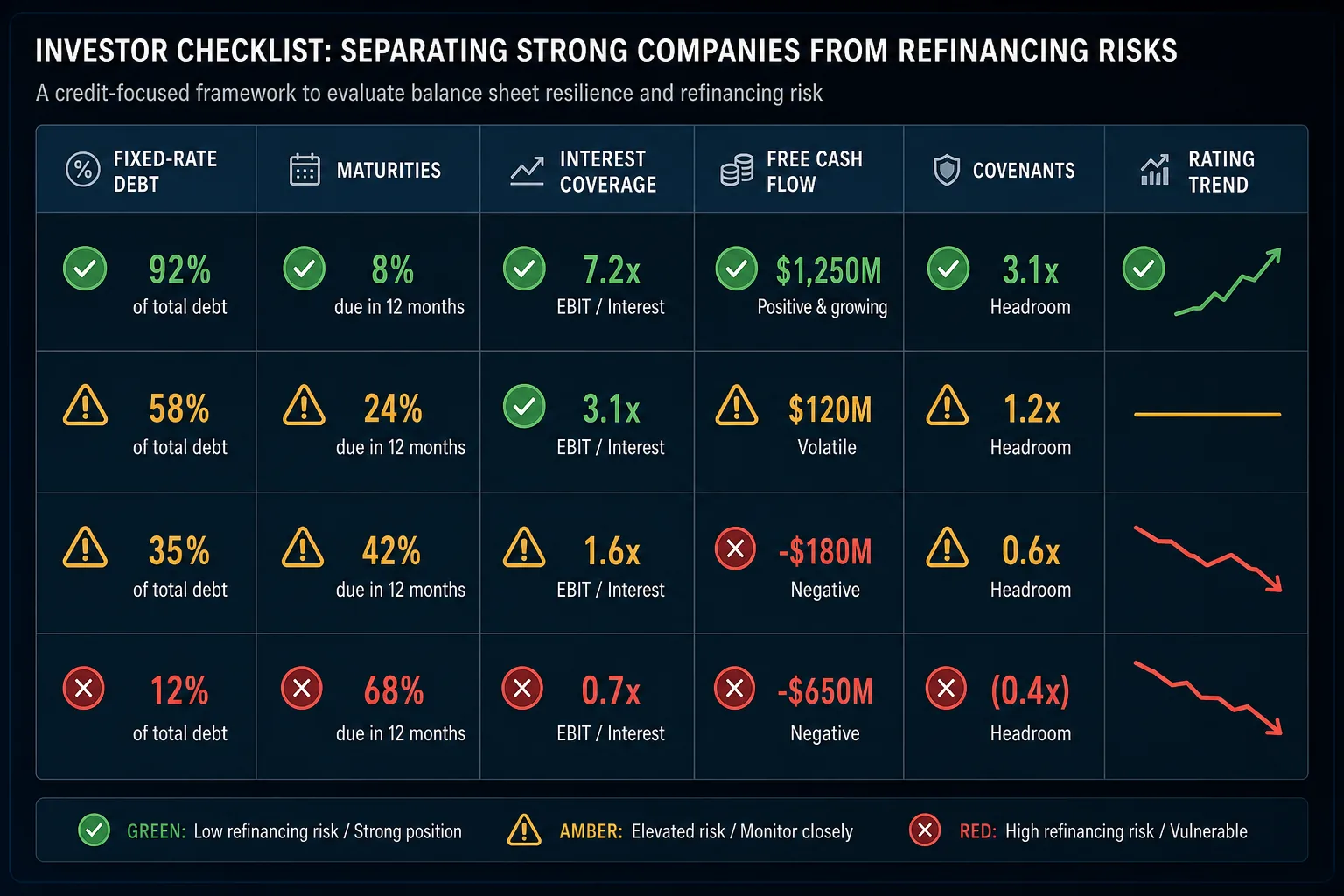
Two companies can each owe $10 billion and have opposite risk profiles. One may have long fixed maturities, recurring revenue, abundant cash and strong interest coverage. The other may rely on floating-rate loans, face a large maturity next year and need optimistic growth merely to meet covenants. Compare net debt with cash flow, not market capitalization. Then inspect the schedule, rate type, currency, collateral, covenants and customer concentration.
How the wall reaches ordinary shareholders
The first visible effect may be lower buybacks rather than default. Management preserves liquidity, capital spending is delayed, acquisitions stop and stock compensation becomes more dilutive. A downgrade can force some bondholders to sell and raise the next refinancing cost. If equity markets are receptive, new shares may solve the balance-sheet problem by transferring value from existing owners to new capital.
Where the risk is concentrated
Risk tends to be higher among businesses with volatile cash flow, weak pricing power, heavy sponsor ownership, substantial floating-rate exposure or assets that are difficult to sell. Commercial real estate remains sensitive because property values and refinancing terms can collide. Private companies deserve special attention: their marks and covenant amendments may reveal stress later than public bond prices do. By contrast, many large public companies retain healthy interest coverage, which is why a broad “corporate debt crisis” headline overstates the evidence.
Why a calm credit market is not a guarantee
Tight credit spreads mean investors demand relatively little additional yield over Treasuries. That reduces near-term financing cost for strong issuers, but it can also signal that markets price little room for disappointment. Watch the dispersion beneath the average: a stable investment-grade index can coexist with sharply widening spreads for lower-quality issuers. Downgrade ratios, distressed exchanges and amend-and-extend deals often deteriorate before the default rate peaks.
My view: expect an earnings filter, not one dramatic explosion
The evidence does not support treating every indebted company as doomed. Aggregate leverage has important cushions and many firms extended maturities. I expect the refinancing wall to behave more like a sorting machine than a single crash: strong cash generators refinance, mediocre companies sacrifice shareholder returns, and fragile borrowers restructure. For stock investors, balance-sheet quality may matter more than a broad prediction about the next Federal Reserve meeting.
Six numbers to pull from a company’s 10-K or 10-Q
- Debt due within 12, 24 and 36 months.
- Weighted-average coupon and proportion that is fixed versus floating.
- Cash plus committed, undrawn credit facilities.
- Operating income divided by cash interest expense.
- Free cash flow after maintenance capital spending.
- Covenant thresholds, collateral and credit-rating outlook.
Frequently asked questions
Is there a single year when the refinancing wall hits?
No. Maturities are distributed by issuer and debt type. Analyze each company’s schedule rather than relying on one market-wide number.
Would Federal Reserve cuts solve the problem?
Cuts could help, especially for floating-rate debt, but credit spreads and company-specific risk can rise even as Treasury yields fall.
What is a distressed exchange?
It is a debt transaction in which creditors accept less favorable terms to help an issuer avoid a conventional default. Rating agencies may still classify it as a default-like event.
Important: This article is for general educational information and does not provide individualized investment, tax, legal or financial advice. Rates, market conditions and company disclosures can change after publication.
Verify the current data
Reviewed and updated August 15, 2026.